
How the Physics of Life Could Help Prevent Birth Defects and Disease
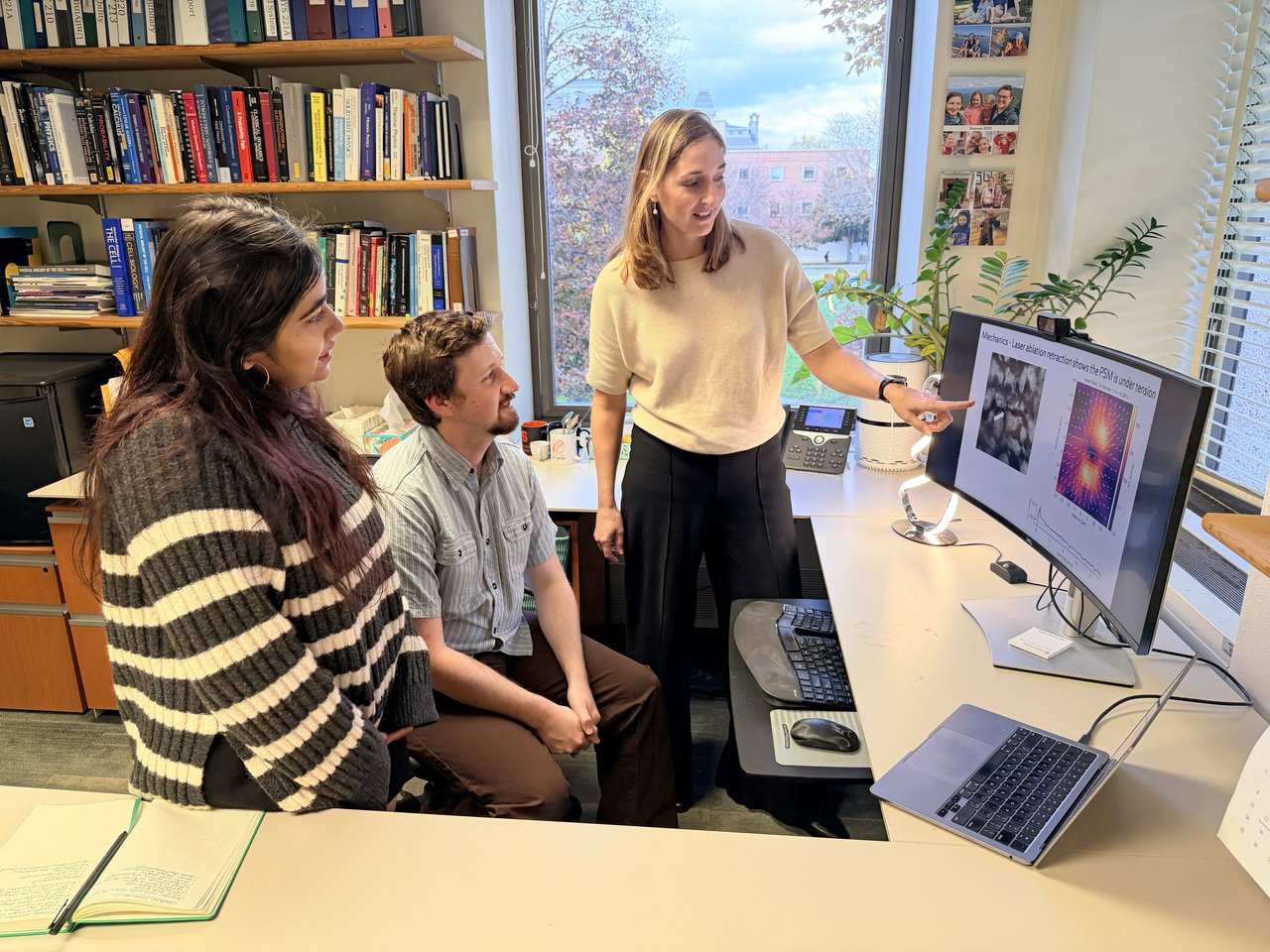
Genes have long been considered the blueprint that tells an embryo how to build a heart, a limb or an organ. But scientists increasingly recognize that genes are only part of the story. As cells push, pull and interact with one another, physical forces help shape the body's earliest development, influencing everything from organ formation to susceptibility to disease.
For Lisa Manning, the William R. Kenan, Jr. Professor of Physics in Syracuse University's College of Arts and Sciences (A&S), understanding those forces is a pathway toward addressing urgent questions around congenital birth defects, cancer progression and regenerative medicine. Her work, which combines advanced computational modeling, physics and biology to uncover how living tissues organize themselves and what happens when those processes fail, sits at the intersection of A&S’ Academic Strategic Plan pillars of Health and Well-Being and Innovative Technologies. Her research demonstrates how discoveries made across disciplines can help address grand challenges facing society.
The Forces that Shape Life
That interdisciplinary approach recently yielded new insights in a paper published in the Proceedings of the National Academy of Sciences, where she teamed up with former Syracuse University postdoctoral researcher Sadjad Arzash and Andrea Liu of the University of Pennsylvania.
Their study offers a new framework for understanding convergent extension, a process that allows tissues to elongate during embryonic development. The researchers found that tissues can achieve complex developmental outcomes through simple, local mechanical feedback between cells without requiring centralized control. The findings provide new insight into morphogenesis (the process through which an embryo takes shape) and demonstrate how concepts from physics can help explain biological self-organization.
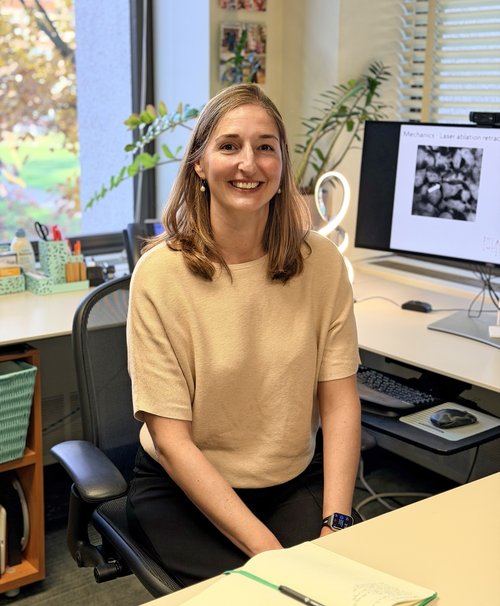
"At early stages of development, there is no brain or external processor to coordinate shape changes in the embryo," Manning says. "The information processing has to be done in situ, within the tissue itself."
The study demonstrated that complex developmental changes can emerge through simple interactions between neighboring cells. According to Manning, the findings provide researchers with a powerful new framework for predicting how local cellular feedback can generate large-scale tissue behavior.
"The significance of our work is that it provides a method for predicting those local feedbacks just by looking at the large-scale behavior of the tissue," she says. "It's a very general method for generating hypotheses that can then be tested in experiments in all sorts of biological systems."
Fixing a ‘Hot Mess’
The impact of the work has recently been recognized through several major research awards, including a $1.2 million National Institutes of Health (NIH) R01 grant. This project addresses a longstanding challenge in developmental biology regarding mesenchymal tissues, which play a critical role in shaping the embryo and are implicated in congenital disorders and cancer metastasis.
"As one of my colleagues who works on mesenchymal tissues likes to say, they are a 'hot mess,'" Manning says. "They are really understudied because the cells change shape all the time, which means there are a bunch of fundamental open questions."
Those questions have significant implications for human health. Defects in tissue elongation can contribute to conditions such as caudal regression syndrome, Robinow syndrome and limb development abnormalities. Manning's team hopes its computational models will help uncover how those defects arise and eventually point researchers toward new treatments.
"We know that defects in forming a network of mesenchymal cells can lead to congenital disease, and long-term we think our work might help identify targets for future therapeutics," she says.
Solving the Left-Right Puzzle
A second NIH-supported project, funded through a $500,000 R56 grant, examines one of the earliest and most important steps in embryonic development: establishing the body's left-right axis. Manning is co-principal investigator on the project with Jeff Amack of SUNY Upstate Medical University.
Determining the body's left-right orientation is a critical developmental milestone. "If the embryo gets it wrong, it can lead to all sorts of congenital defects, including heart looping defects that are relatively common and problematic," Manning says.
By integrating live imaging, experimental biology and computational modeling, the researchers aim to uncover how cells organize themselves to establish proper fluid flow within the left-right organizer. The findings could provide new insights into congenital heart defects and other developmental disorders, advancing efforts to improve human health through a deeper understanding of early development.
Decoding the Evolution of Shape
Manning's interest in how physical principles shape biological form also extends beyond early embryonic development. She recently joined a Simons Foundation Target Grant led by Lakshminarayanan Mahadevan of Harvard University that seeks to understand how mammalian skull shapes develop and evolve. The project brings together researchers from mathematics, physics and biology to uncover the rules governing the emergence of complex anatomical structures.
"There’s an amazing fossil record about how skulls change shape over evolution, and it begs the question: How does biology generate shapes, and how do small changes to cell DNA over time lead to different shapes?" Manning says.
By answering those questions, researchers hope to better understand the fundamental processes that drive development and evolution, shedding light on how genetic changes give rise to the extraordinary diversity of forms seen across species.
"This is a great example of all of us pushing the boundaries of what we can do to try to answer a big-picture question," she says.
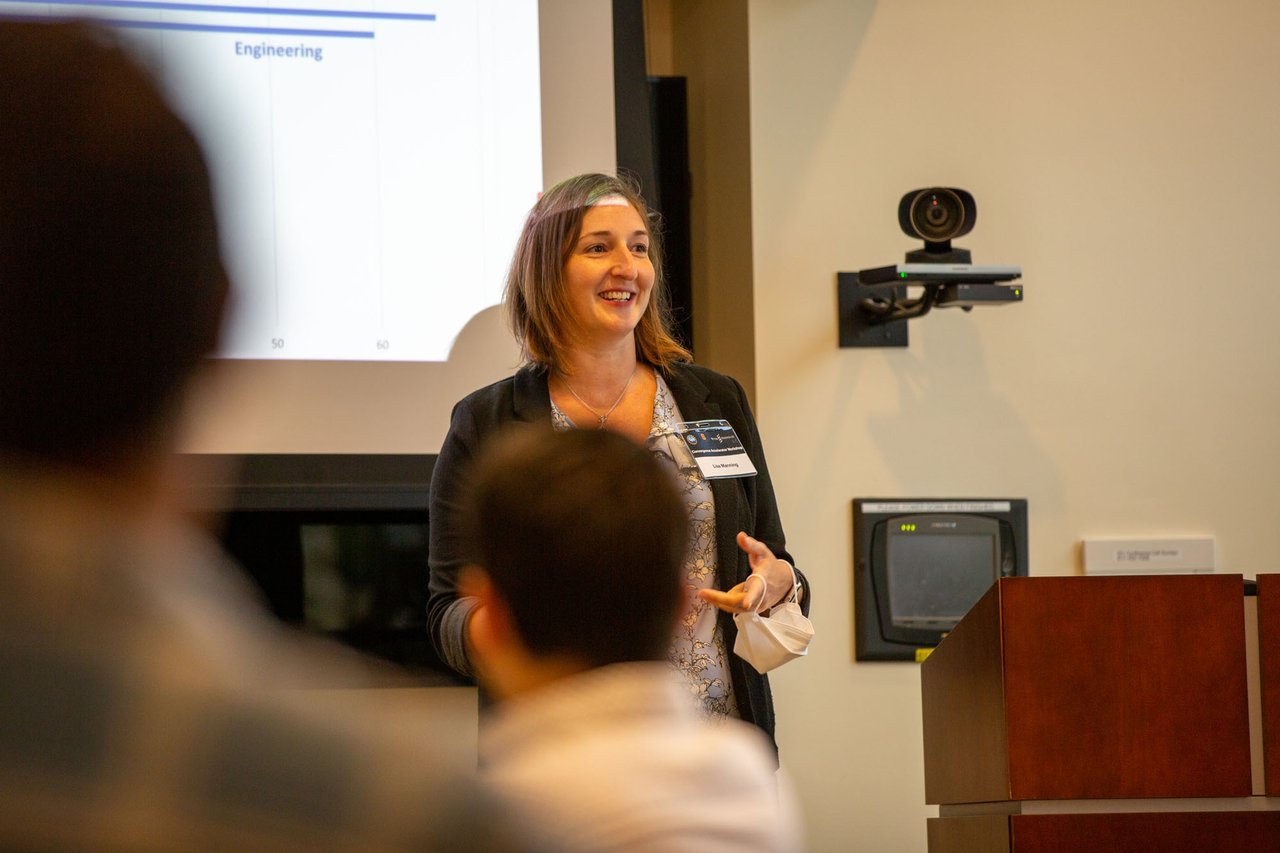
Manning sees this type of interdisciplinary collaboration as essential for tackling society's most pressing challenges. As a member of Syracuse University's BioInspired Institute, where she served as founding director, and current director of a National Science Foundation-funded NRT interdisciplinary graduate training program, she and other researchers in physics, biology, engineering, mathematics and computation work together to uncover the principles that enable living systems to process information, adapt and solve problems, with the goal of applying those discoveries to medicine, materials science and emerging technologies.
"These types of problems really require a lot of interactions," Manning says. "You need to be able to communicate across different areas of expertise."
From Fundamental Discovery to Human Impact
Manning's research reflects a growing understanding that biology cannot be explained by genes alone. Physical forces, mechanical interactions and collective cellular behavior also shape how organisms develop and how diseases emerge.
"I like to think of what we're doing now as a swinging back of the pendulum towards a balance between genes and forces," Manning says. "The interplay between gene-based blueprints and self-organized, force-based interactions between cells is required to generate something as complex as an animal."
By uncovering those interactions, Manning and her collaborators are advancing knowledge at the frontiers of physics and biology while addressing some of the most significant challenges in human health. Their work demonstrates how interdisciplinary research can translate fundamental scientific discovery into insights with the potential to improve lives.
Published: Nov. 13, 2026
Media Contact: asnews@syr.edu