
Fellowship Funds A&S Student’s Study on How Brains Combine Senses
Key Takeaways:
- Syracuse senior Taylor Powell won a 2026-27 McKnight Pecot Fellowship for her fruit fly research on how brains integrate senses for decision making.
- Using optogenetics, she’ll study how larvae respond when sensory signals align or conflict and how hunger affects that response.
- Findings from the research could help scientists better understand how the brain combines sensory information, a process that is often disrupted in neurological and developmental disorders.
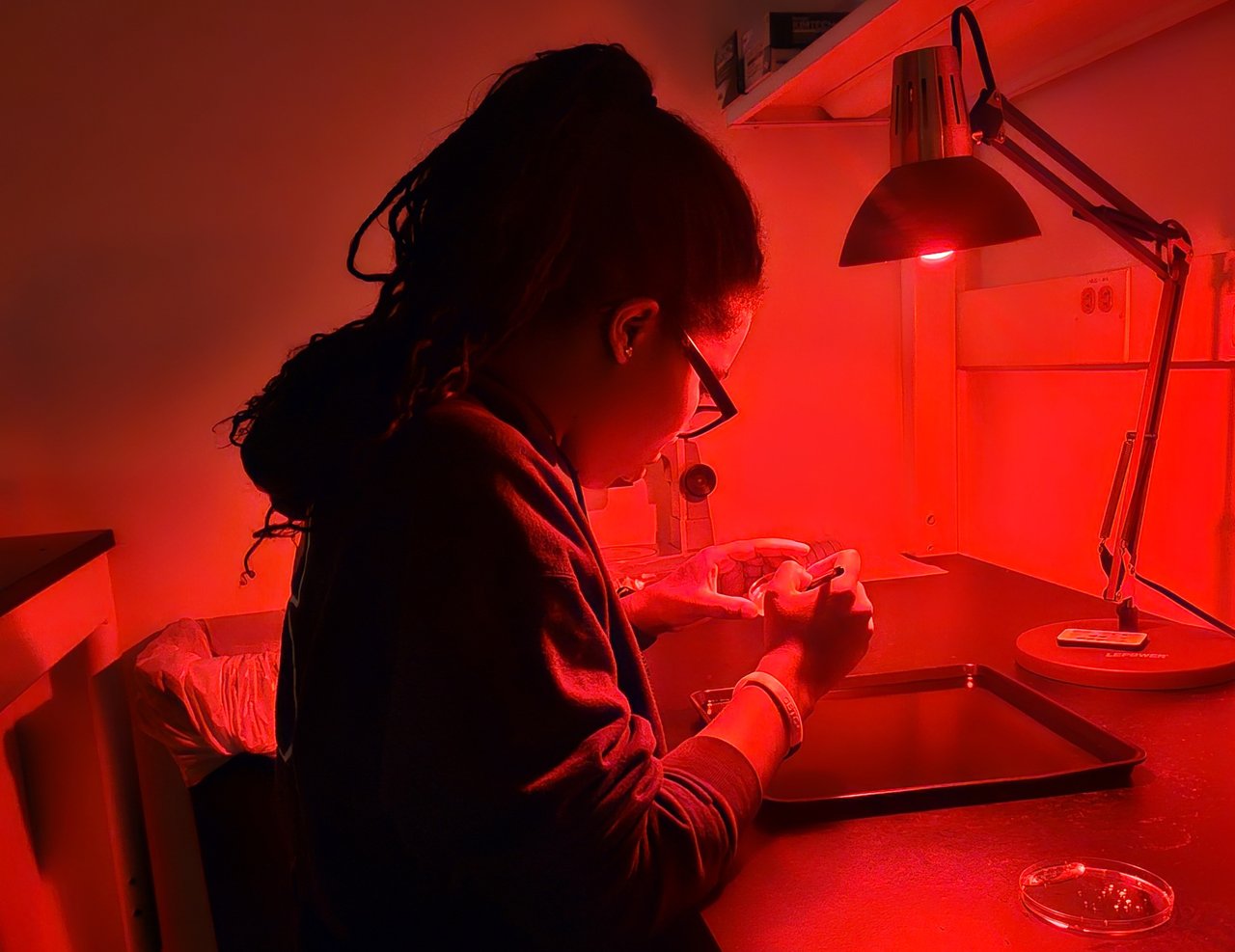
Fruit fly larvae crawl through alternating blue and red light in a large behavioral arena as Taylor Powell tracks whether they turn or keep moving forward. Those choices can reveal how their brains combine different kinds of sensory information to guide behavior.
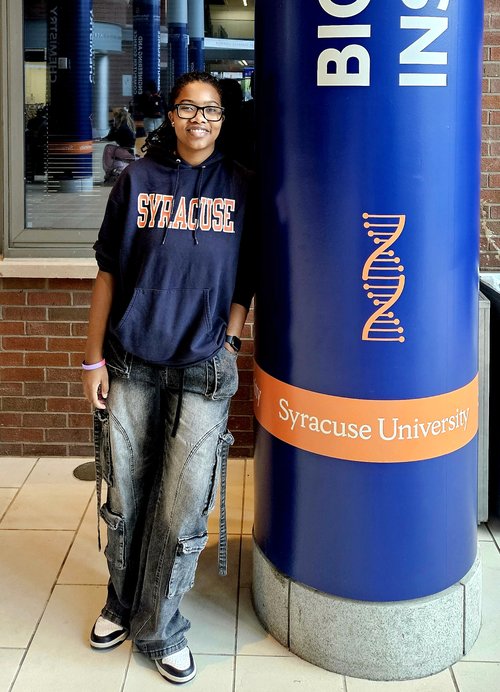
Powell, a senior double majoring in neuroscience and biotechnology in the College of Arts and Sciences (A&S) at Syracuse University, has spent nearly two years in the lab of physicist Mirna Mihovilovic Skanata. The work has earned her a 2026-27 McKnight Pecot Fellowship, a one-year research and mentorship program for students from underrepresented communities pursuing neuroscience.
“Taylor is very independent, and she applies herself in the lab,” says Skanata, assistant professor of physics in A&S. “She’s driven to learn more and reads scientific papers on her own and asks thoughtful questions based on what she’s read.”
How the Brain Combines Senses
Animals constantly combine information from their senses to decide what to do next. The fruit fly larva has a relatively simple nervous system that researchers can map in detail. That makes it possible to trace how different sensory signals come together to shape behavior.
These larvae can sense both light and odors, avoiding light while navigating toward appealing scents and away from unpleasant ones.
Powell will apply optogenetics, using light to control the activity of specific neurons. Optogenetics has become a widely used tool in neuroscience laboratories and was recognized recently with the 2026 Nobel Prize in Physiology or Medicine. The lab breeds fruit flies so that certain neurons can be switched on with red light. Researchers can then observe how activating those neurons affects the larvae’s behavior.
Powell will present the larvae with blue light visual stimulus alongside an optogenetic odor presentation, then quantify how the larvae respond when the two sensory signals are in conflict or in alignment. She will also examine how hunger changes those responses, Skanata says.
“The project could help the lab learn whether attractive and aversive odor signals are combined with light in the same way or through different brain circuits,” says Skanata. “The overarching goal is to understand the mechanisms the brain uses to combine sensory information—for example, when signals are added together or when one signal suppresses another.”
The questions reach past the lab. Many neurological and developmental conditions in humans include difficulty combining sensory information. Understanding how a simpler nervous system combines sensory information could eventually help researchers better understand similar processes in the human brain.
From Shadowing to Running Experiments
Powell joined the lab in the spring of her sophomore year. She started by shadowing postdoctoral researcher Silverio Johnson. Now she runs her own experiments and helps keep the lab going day to day: managing fly cages, collecting larvae and preparing fly food.
She credits the lab’s supportive atmosphere and mentorship for her growth as a scientist.
The lab records brain activity in freely moving larvae with a specialized microscope, but Powell’s fellowship work centers on behavior, which Skanata says suits Powell’s training.
The fellowship grew out of Skanata’s own work. She previously received a McKnight Technological Innovations in Neuroscience Award, given to three scientists nationally each year, for developing two-photon microscopy technology to track and record neural activity in freely moving larvae. The award enabled her to nominate Powell as an undergraduate for the separate Pecot fellowship.
At the end of the term, the two will attend a conference, where Powell will present a poster on her project. Skanata says the fellowship will deepen Powell’s research experience and connect her with the neuroscience community.
Powell has been accepted into Syracuse’s master’s program in biotechnology and hopes to stay in the lab. After that, she wants to earn a doctorate in neuroscience and work on clinical trials for people with neurodegenerative diseases.
For now, the question in front of her is simpler: What does a larva do when what it sees and what it smells do not agree?
Published: Oct. 8, 2026
Media Contact: asnews@syr.edu