
A&S Researchers Link Metal Deposits to Oceanic Oxygen Loss During Ancient Ice Ages
Key Takeaways:
- Oxygen puzzle: Syracuse scientists analyzed more than 27,000 ancient seafloor samples, finding that Earth’s oceans lost oxygen during major ice ages, not just when the Earth was warmer, as scientists had long thought.
- Tropical depletion: The team analyzed manganese concentrations, an oxygenation indicator, from pole to equator and found significant latitudinal difference. Tropical oceans consistently deposited less manganese than polar regions associated with all six ice ages studied.
- Metal pattern: The manganese latitudinal pattern was most extreme during very old extreme glacial events. It diminished over time as atmospheric oxygen rose.
Earth’s oceans went through oxygen loss to produce metal deposits repeatedly during the planet’s deepest ice ages. The findings, published in Nature Communications, suggest that ocean deoxygenation is not exclusively a consequence of warmer climate periods but has occurred under dramatically different climate conditions.
An international team of researchers analyzed manganese and other chemical signatures preserved in more than 27,000 ancient seafloor samples collected from six continents. Across six major glaciations spanning more than two billion years, they found the same pattern: sediments from high latitudes consistently contained more manganese than those from tropical regions. The researchers interpret this contrast as evidence that polar oceans remained comparatively rich in oxygen, a condition required for manganese enrichment.
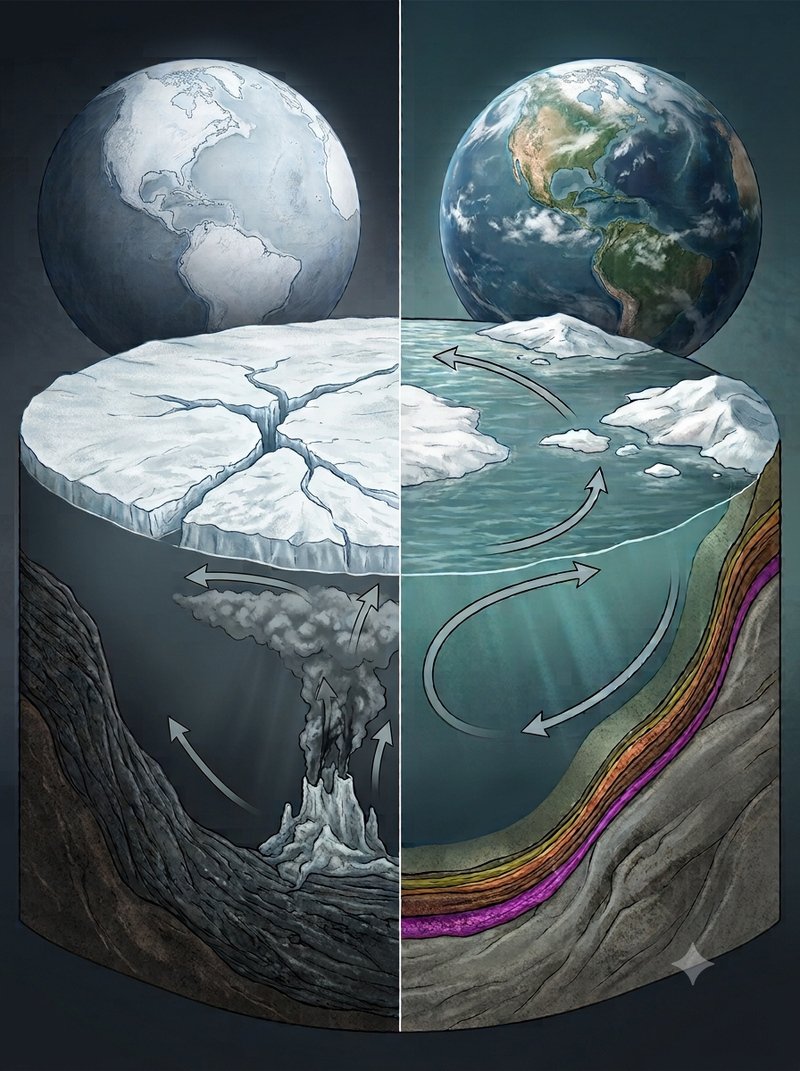
This illustration contrasts Earth's oceans during ancient glaciations (left) with deglacial conditions (right). Syracuse University researchers found that oceans lost oxygen not just during warm periods, but repeatedly during Earth's deepest ice ages, a pattern preserved in manganese deposits within ancient seafloor rock. (Courtesy: Xubin Wang, generated with AI)
“When we look at the geological history of metals, we can learn about the evolution of atmosphere, ocean and life,” says Zunli Lu, professor of Earth and environmental sciences in the College of Arts and Sciences at Syracuse University.
Unearthing Secrets of Ancient Oceans
First author Xubin Wang, a postdoctoral researcher at Syracuse University, focused on manganese-rich marine sediments deposited during glaciations ranging from the Huronian Ice Age, roughly 2.4 billion years ago, to the Late Paleozoic Ice Age, which ended about 260 million years ago.
Manganese serves as a chemical archive of ancient ocean conditions. In oxygen-poor waters, the metal dissolves into seawater. When oxygen returns, it precipitates and accumulates in seafloor sediments.
The study’s key advance was examining how manganese concentrations varied from the poles to the equator, a geographic perspective that has received little attention.
“We found a clear latitudinal manganese gradient during glaciation events—a significant difference between high and low latitudes,” says Wang. “When we analyzed the background, non-glacial periods, the gradient was almost flat. But during ice ages, it becomes very steep.”
Big Data
The scale of the analysis is also unusual.
“500 data points would already be considered extremely good for typical geochemical investigations. In this case, we had the chance to work on 20,000 to 30,000 geological samples to dissect ocean environment in 4 dimensions. Latitudinal patterns of rock geochemistry may tell many new stories but have not been fully explored in these large datasets” Lu says.
Those samples came from the Deep-Time Marine Sedimentary Element Database, which compiles data from North America, South America, Europe, Asia, Africa and Oceania.
To strengthen their conclusions, the researchers compared manganese with other chemical tracers. Trace metals such as molybdenum and uranium, which respond in the opposite way to changing oxygen levels, displayed inverse latitudinal patterns, independently supporting the interpretation that oxygen availability drove the observed differences.
Alexandre Pohl of Université de Bourgogne in France conducted ocean simulations using the cGENIE Earth system model. The simulations matched the sediment record, indicating oxygen-poor upper oceans in the tropics.
The strongest manganese gradients appeared during the Proterozoic Snowball Earth episodes, when ice may have enveloped nearly the entire planet and atmospheric oxygen concentrations were far below modern levels. During the Paleozoic, as atmospheric oxygen gradually approached today’s values, the manganese gradients weakened but remained detectable during major ice ages. That long-term flattening mirrors the gradual rise of oxygen in Earth's atmosphere.
Climate, Oxygen and Habitability
The findings suggest that there are still many unknowns in how global wind and ocean circulations changed in different climate states to impact ocean oxygen and habitability.
“For decades, scientists have argued that warming would lead to the expansion of marine dead zones. Mounting evidence points to multiple cases of ocean deoxygenation during cooling related to mass extinctions. I think a more nuanced view on the connections among climate, oxygen and habitability will help our society adapt to future environmental changes” Lu says.
The research was supported by the National Science Foundation and the Thonis Family Postdoctoral Research Fellowship. Climate modeling relied on high-performance computing facilities in France, and the project also contributes to UNESCO's IGCP 735 initiative, which investigates the geological record of Earth's early environments and the rise of ancient life.
The Thonis fellowship funded the postdoctoral position that made this project possible, giving Wang the time and support to work with tens of thousands of global rock samples. It also reveals a scientific continuity. Founder Mike Thonis published a Nature paper on manganese and tectonics as a Harvard master’s student 20 years ago, and now the first Thonis postdoc has produced another major manganese study revealing fundamental patterns in Earth’s ancient oceans.
Citation: Wang, X., Pohl, A., Rickaby, R.E.M. et al. Latitudinal manganese gradient dynamics associated with Earth’s major ice ages. Nat Commun (2026). https://doi.org/10.1038/s41467-026-75597-2
Published: July 15, 2026
Media Contact: asnews@syr.edu