
A&S Earth Sciences Professor Honored as 40 Under 40 Rising Star
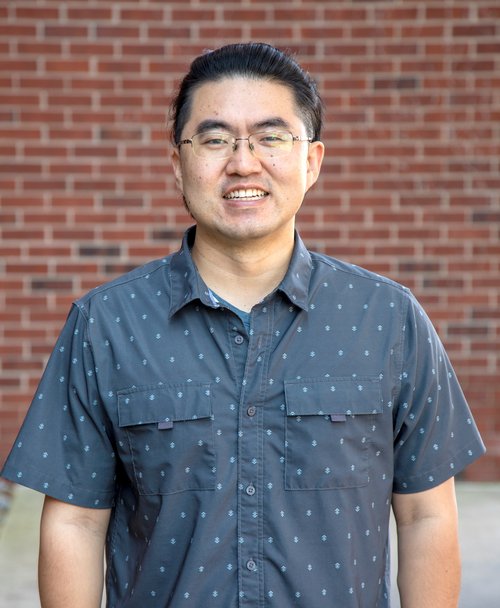
Tao Wen, associate professor in the Department of Earth and Environmental Sciences (EES) in the College of Arts and Sciences (A&S), has been named a 2026 “40 Under 40” honoree by the American Academy of Environmental Engineers and Scientists (AAEES). The “40 Under 40” distinction recognizes emerging leaders who are advancing environmental engineering and science through their research and service. Honorees are selected by a panel of past recipients, who evaluate both professional accomplishments and broader civic or philanthropic impact.
Wen’s recognition reflects an innovative and interdisciplinary research program focused on addressing some of today’s most pressing environmental challenges, including freshwater salinization, groundwater contamination and energy-water interactions. His work integrates hydrogeochemistry, hydrology and environmental data science to better understand water quality and how natural systems respond to human activities, climate variability and environmental change. His research has been supported by major federal agencies, including the National Science Foundation and the U.S. Department of Energy, and has resulted in more than 45 peer-reviewed publications in leading journals.
A professor in A&S since 2020, Wen leads the Hydrogeochemistry and Environmental Data Sciences (HANDS) Lab and the Noble Gases in Earth Systems Tracing (NEST) Lab, where his team develops predictive, data-driven tools that transform complex environmental data into practical insights that help protect water resources, inform policy decisions and reduce risks to communities. His group’s work includes machine learning and physics-informed modeling approaches that quantify water-quality risks, freshwater salinity, alkalinity and carbon-related fluxes across large spatial scales.
Wen is also a leader in open environmental data infrastructure. He serves as principal investigator and database manager of the Shale Network, a nationally used platform that brings together environmental monitoring data from tens of thousands of sites. By making complex datasets more accessible to researchers, regulators, nonprofit organizations and communities, Wen’s work supports evidence-based environmental decision-making and helps translate data-intensive science into public benefit.
This impact is evident in a recent study co-authored by Wen in ACS ES&T Water examining the long-term ecological impacts of oil and gas development in the United States. By analyzing thousands of biological samples from waterways across Pennsylvania, the team found that legacy conventional oil-and-gas infrastructure is more strongly linked to declines in stream biodiversity than newer shale development (fracking).
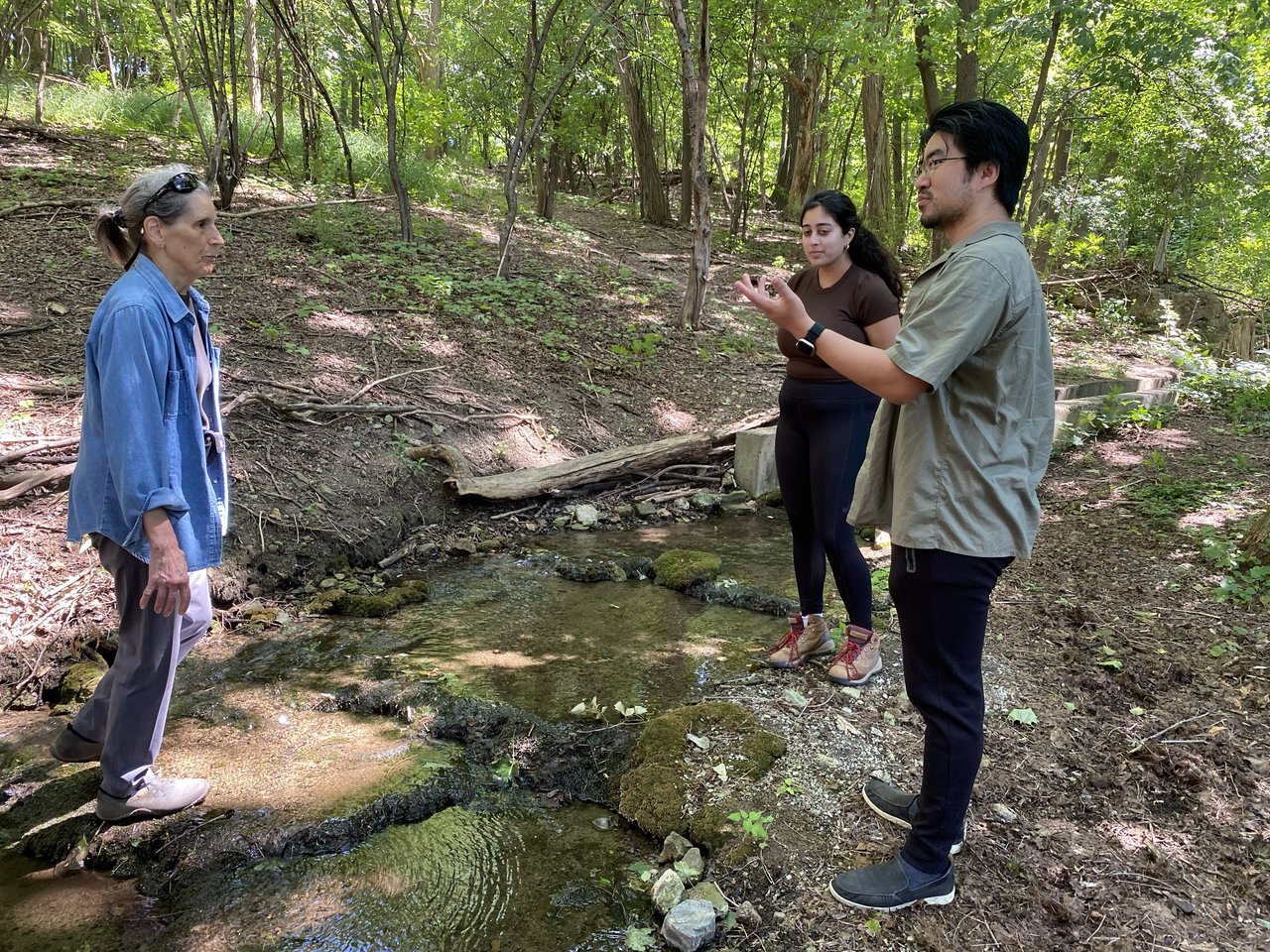
Beyond his published research, Wen is also deeply committed to mentorship, education and community engagement. Through a recent project supported by the Engaged Humanities Network in A&S, he and his students have partnered with Syracuse residents to monitor urban waterways, seeking to better understand how extreme weather and environmental change affect neighborhood ecosystems and public safety. Their work aims to inform more responsive, community-centered urban planning.
Wen’s service also extends across the broader environmental science and hydrology communities. He has served as chair of the Geological Society of America’s Geoinformatics and Data Science Division; chair of the Education and Outreach Committee for the Consortium of Universities for the Advancement of Hydrologic Science, Inc. (CUAHSI); a member of the CUAHSI Board of Directors; and an associate editor for Applied Geochemistry and Geoscience Data Journal.
Through his research, teaching, mentorship and service, Wen demonstrates how environmental scholars can not only advance scientific knowledge but also translate it into meaningful, real-world solutions. His recognition as a “40 Under 40” honoree underscores his growing impact on the field and his leadership in using data-driven, community-engaged science to address complex environmental challenges with societal relevance.
Published: June 1, 2026
Media Contact: asnews@syr.edu