
A&S Scientists Design Proteins With No Fixed Shape
Key Takeaways:
New Protein Design: GOOSE allows researchers to design intrinsically disordered proteins (IDPs) under specific constraints, enabling proteins that self-assemble and protect cells.
Student Research: Syracuse emphasizes hands-on research with students who play key roles in validating GOOSE's predictions, positioning the university as a leader in disordered-protein research.
Practical Implications. Because of their lack of structure, designed IDPs can have unique functions. The work opens up the possibility of designing novel proteins that can protect cells from drying and freezing, improve the durability of cell and gene therapies, or make crops more resilient to drought.
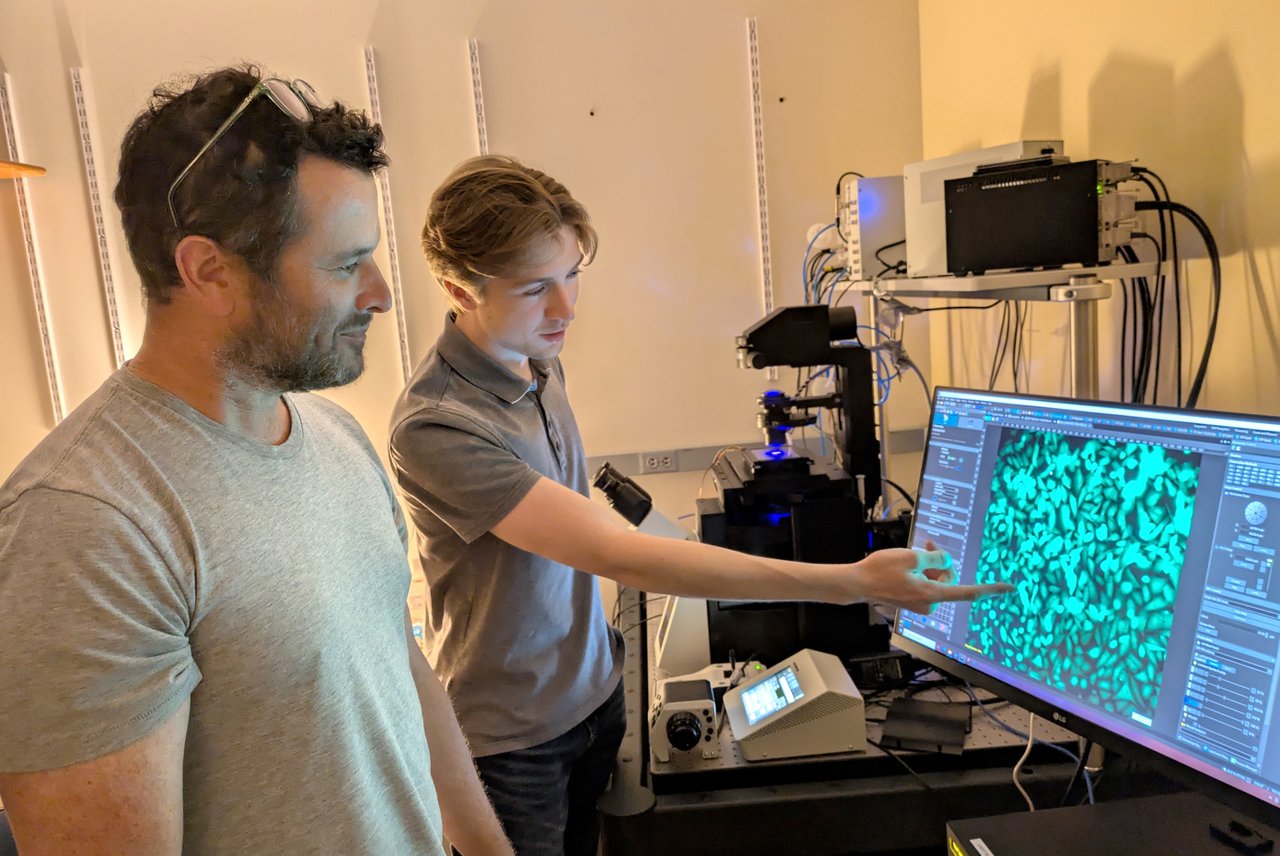
Researchers at Syracuse University have co-built a computational tool named GOOSE that lets scientists design intrinsically disordered proteins (IDPs). These are biologically active proteins or regions that lack a fixed 3D structure. The work, done in collaboration with researchers at Washington University School of Medicine in St. Louis, is described in a study published in Nature.
Protein design has thus far mostly focused on folded proteins, which have a specific three-dimensional shape from which their function is derived. The design of folded proteins won the 2024 Nobel Prize in Chemistry. But IDPs don’t work that way: instead of a fixed three-dimensional structure, they shift shapes constantly, making it difficult to determine their function. Because of this, few tools existed to design functional IDPs.
“For decades, these floppy, spaghetti-like proteins were written off as junk,” says Shahar Sukenik, associate professor in the Department of Chemistry at Syracuse University’s College of Arts and Sciences (A&S), who led the project. “But they make up a large portion of the human proteome, and they’re critical to the way many of our proteins function. Despite this, the rules that let us design traditional, folded proteins simply don’t work for them. This study is a first step toward decoding the rules for IDP function.”
A New Rulebook
GOOSE helps researchers identify this new rulebook. This platform generates disordered protein sequences under precise, user-defined constraints, then lets scientists test them computationally or in the lab to see what they do inside a cell.
“Proteins are written in amino acids—these are like the words in a sentence,” notes Sukenik. “Arrange them in the right order, and the sentence makes sense (meaning the protein can function). But arrange them in the wrong order—and you lose all meaning.”
For well-folded proteins, the way to order the amino acids is well understood, but IDPs have a different set of rules.
“GOOSE allows you to write thousands of these ‘sentences’—or amino acid sequences—in a matter of seconds. For example, you can request a disordered region that's 60 amino acids long and the ends separated by five nanometers on average. The software then incorporates machine learning networks and generates hundreds of sequences under those constraints in seconds,” Sukenik says. “Pair these sequences with computational and experimental methods to measure function, and we can now map the way amino acids are arranged in IDPs to their function.”
The team at Syracuse did exactly that: they designed novel disordered proteins that can sense their environment, self-assemble inside the cell, and protect cells from dehydration. Downstream applications of this work might include designing IDPs that can then be inserted into genetically modified crops to protect them from desiccation, or the design of novel formulations that significantly prolong the shelf life of therapeutics.
Students Driving Discovery
Syracuse graduate student Kara Hunter and Trevor Brandt, who began the project as an undergraduate, are the first authors on the paper and helped design as well as experimentally measure GOOSE-designed sequences. They have worked together with undergraduate students, including Lea Day from Syracuse’s Biology Distinction Program and Brooke Nichols from Onondaga Community College who came to work in the lab under an NSF-funded summer program for several months.
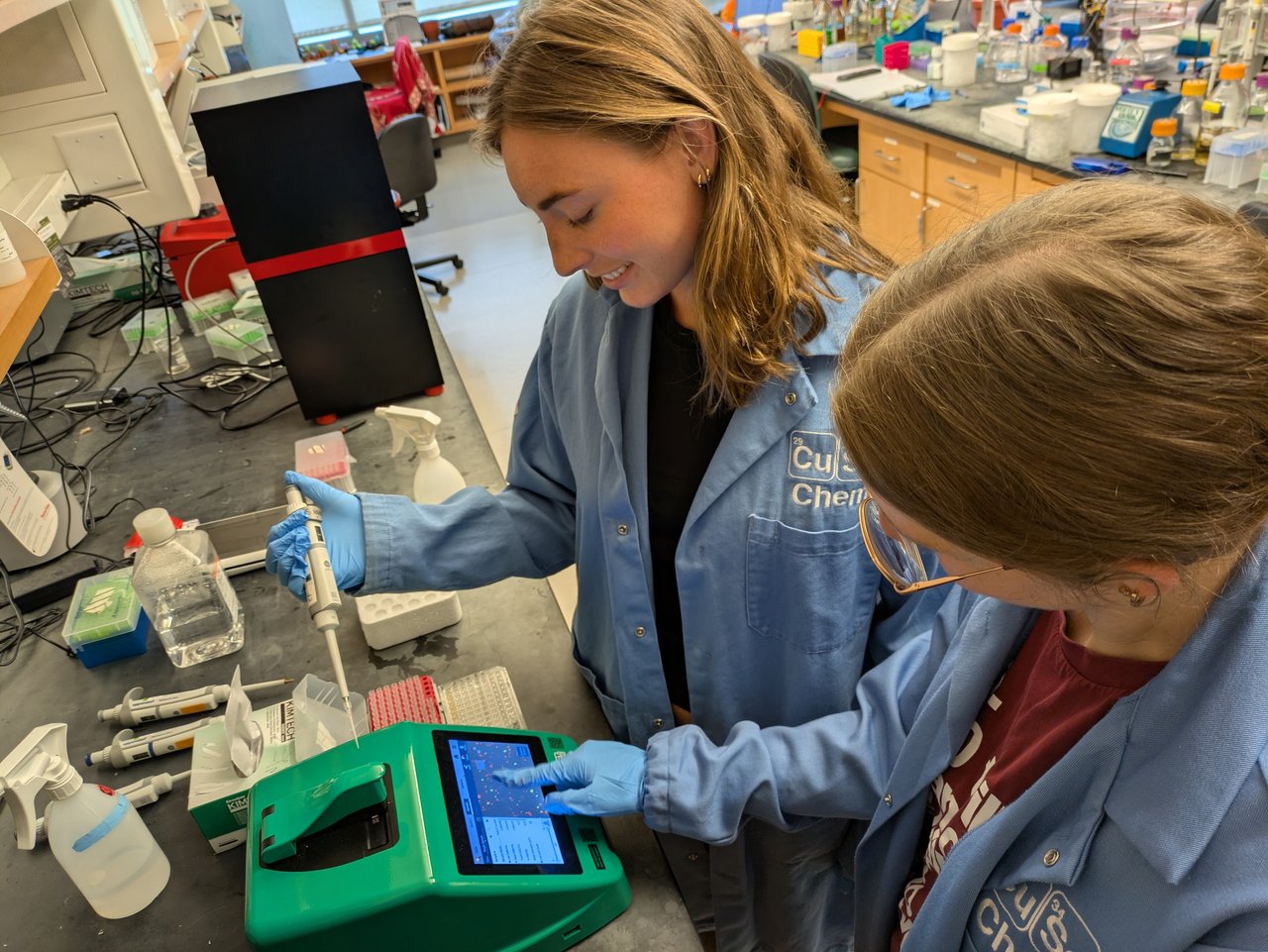
“One of the things Syracuse does exceptionally well is embed undergraduates in real, cutting-edge research,” Sukenik says. “Students come in as early as their sophomore year, learn to build tools, run experiments, analyze the data, and take an active part in scientific discovery.”
This project was funded by the National Institutes of Health and the National Science Foundation, but also by a key investment by Syracuse in an important emerging field. Syracuse is becoming an important center for research on IDPs, thanks to a strategic hiring of faculty. “Syracuse made a deliberate decision to invest in intrinsically disordered protein research, and that commitment is exactly why this work is happening here,” says Sukenik.
This fall, Syracuse will host a regional symposium on intrinsically disordered proteins, bringing together researchers from across the region. “We’re positioning the university as a hub for this emerging field,” Sukenik adds. Learn more about the Function without Form Conference.
Published: July 29, 2026
Media Contact: asnews@syr.edu