
The Test Got It Right
Every great teacher wasn’t necessarily a great student, as one of Syracuse University’s longest-tenured professors demonstrates.
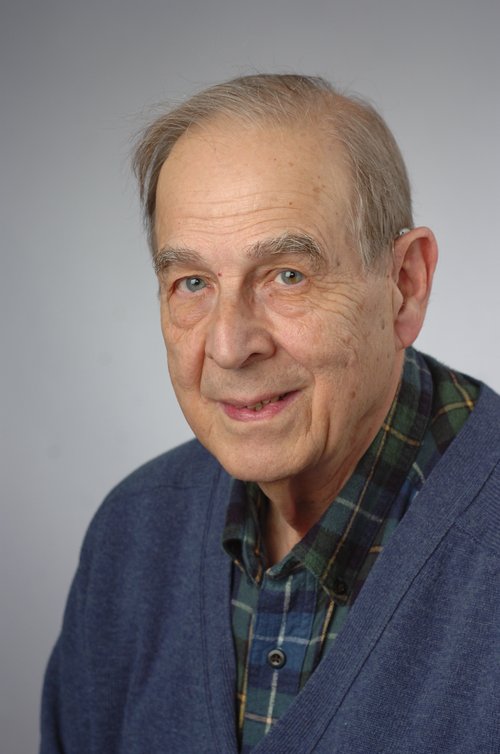
Jack Graver likes to tell the story about a vocational aptitude test he took in sixth grade. It asked students which activities they preferred — things like fixing a bicycle, building things, or working with people. When the results came back, they said he was best suited to be a teacher.
That gave everyone who knew him a good laugh.
"How the hell is this guy going to teach when he can't get through his own courses?" Graver recalls them saying.
He was dyslexic before the word was widely known. To his teachers, he was just lazy. Reading and writing were extremely difficult and he failed German four times. A Latin professor even gave him a D and kindly asked him not to come back for the second semester.
This spring, Graver retires from the Department of Mathematics in the College of Arts and Sciences (A&S) after 60 years on the faculty. The “lazy” student who struggled to read and write has authored five books and dozens of research papers spanning multiple mathematical fields. One such paper, originally dismissed as of no practical value, became foundational to algorithm design a decade later. The aptitude test, it turns out, was right.
Finding His Way to Syracuse
Graver grew up in Cincinnati, Ohio, in a working-class family, with no path to college.
After two years in the Navy, he used the G.I. Bill to attend Miami University in Ohio, where he planned to study forestry. A mentor redirected him toward a mathematics major instead and another visiting mathematician took him under his wing. By the time Graver finished his Ph.D. at Indiana University in 1964, his philosophy of teaching was already taking shape.
His first faculty position was a postdoctoral instructorship at Dartmouth. Combinatorics, the field of math related to counting and properties of finite structures, was more active in Canada than in the United States at the time. As it emerged as his specialty, Graver interviewed at the Universities of Alberta and Manitoba. Both offered him positions, but he still opted to interview at Syracuse University.
"This was a very, very friendly place," he says. "One of the most collegial schools."
Graver chose Syracuse and has been here ever since.
Working in the Corners
In a document he calls his "Mathematical Obituary," Graver describes the research philosophy that guided his career with characteristic frankness. Rather than compete with the hotshots of the day who worked on the big, popular problems, he learned to “work in the corners,” that is, find the connections others had walked past.
"I wasn't setting out to make big changes," he writes. "I just wanted to understand things better, and the research followed."
That approach produced a body of work that moved across a variety of mathematical fields — algebraic topology, combinatorics and graph theory, rigidity theory, integer linear programming and, most recently, the combinatorial structure of fullerenes. His 1975 paper "On the Foundation of Integer Linear Programming I" was dismissed by its original referee as interesting but of no practical value. A decade later, as computer memory expanded, it became foundational to algorithm design. He still finds the reversal amusing.
His longest collaboration had been with colleague Mark Watkins. Their textbook Combinatorics with Emphasis on the Theory of Graphs, published in 1977 as volume 54 in Springer's Graduate Texts in Mathematics series, remains a standard reference. Two decades later, the pair produced a second major work together. Graver also co-authored Combinatorial Rigidity with Brigitte and Herman Servatius, published by the American Mathematical Society, and wrote Counting on Frameworks, an accessible treatment of rigidity theory for the Mathematical Association of America.
Collaboration is a key element to Graver’s career. "I like working with coauthors," he says, in part because dyslexia makes solo writing slow and error-prone. He is currently working on another book with a former graduate student.
The Standing Ovation
Throughout his career, one of Graver’s greatest strengths has been his ability to understand students. Because he had struggled with reading and languages, he could relate to struggling students. He told his statistics students about failing German or that Latin professor.
His work with K-12 teachers began in graduate school, when he was assigned the one course he says no other graduate students wanted: mathematics for elementary school teachers. He loved it. When Indiana mandated that existing teachers earn bachelor's degrees or lose their jobs, he designed a course that worked through a curriculum teachers had been delivering for years without ever grasping.
"You've been teaching long division your whole career," he remembers asking. "Have you ever wondered how it works?" They would shake their heads. Then they would figure it out together.
That group gave him the only standing ovation of his 67-year teaching career.
He carried that work with him to Syracuse in many ways, including NSF summer institutes, the New York State Regents curriculum revision committee and No Child Left Behind workshops that ran into the early 2000s. He also holds an honorary designation as a New York State high school teacher.
Sixty Years Under Eight Chancellors
Graver served three years as department chair and nearly 15 more as associate chair. The work was meaningful, but exhausting, he says. Looking back, he thinks he was good at the human parts like smoothing faculty relations or sitting with an upset student until they'd said everything they needed to say. He tried to build a collegial office out of a tense one.
He also took graduate students on camping trips to the Adirondacks. For years, Graver and Watkins led groups of international students — including German economics students on exchange — on outdoor excursions at the end of each academic year. When new graduate students arrived at the department's fall orientation, someone would point him out, saying, “That's the one who's going to take you camping.”
The decision to retire was not easy. Graver had kept teaching because he loved it, and because, he notes, his family is “long-lived.”
He taught one course this final semester. It went well. He is leaving, he says, on a high note.
“Jack Graver is quite simply irreplaceable,” says math department chair Graham Leuschke. “A wide-ranging mathematician of international stature, a gifted and deeply empathetic teacher, a patient and generous mentor to students and junior faculty, and a warm, thoughtful colleague, Jack represents the best of the Department of Mathematics. We're deeply grateful for his many contributions over decades and wish him only the best in his next chapter.”
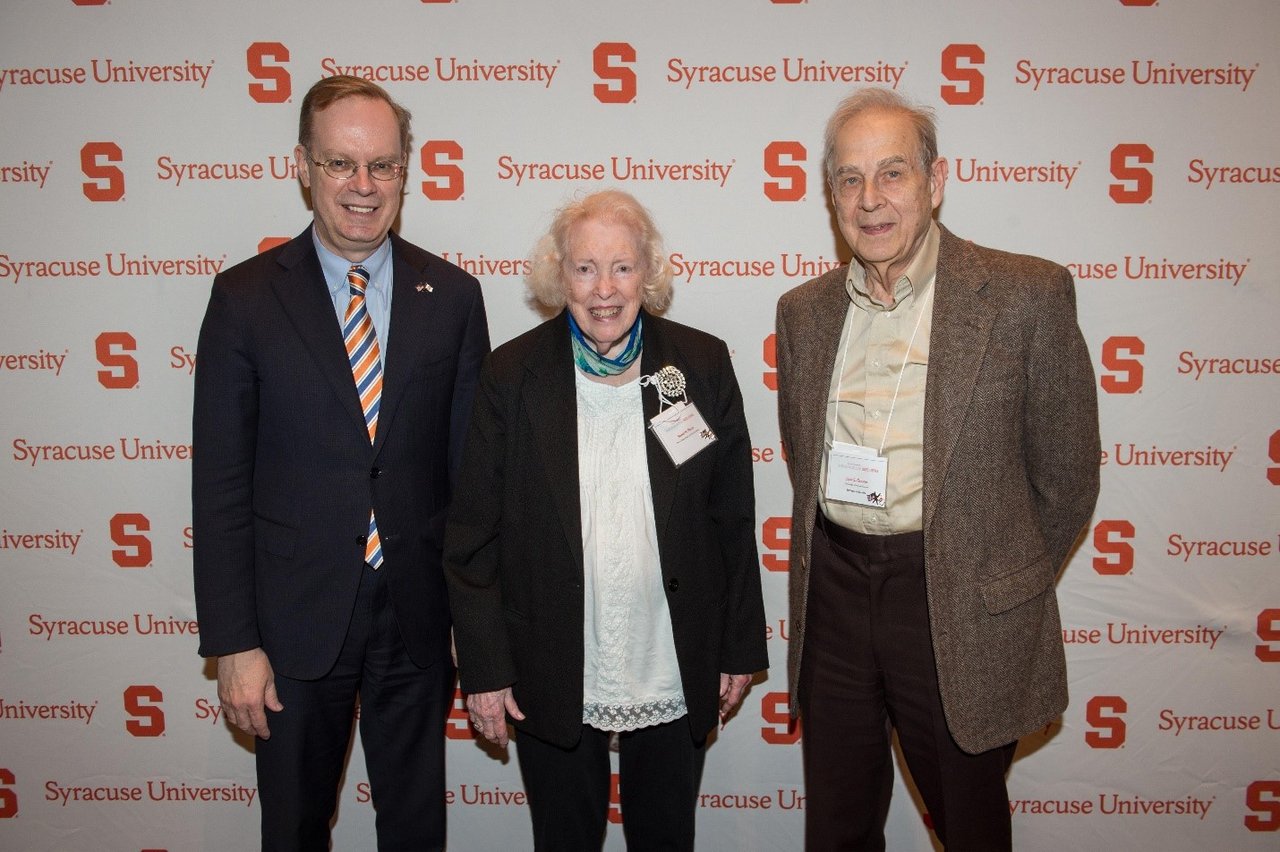
When Mike Haynie became chancellor this spring, it added one more distinction to Graver's remarkable tenure: he has now served under more than half of the chancellors in Syracuse University's history.
Published: May 7, 2026
Media Contact: asnews@syr.edu