
EES Professor Quoted in Scientific American on Decoding Earth’s Climate Past

Tripti Bhattacharya, Thonis Family Professor in the Department of Earth and Environmental Sciences, was quoted in the Scientific American article “Peering into Earth’s climate past is getting ever more bizarre," which highlights the creative and sometimes surprising methods researchers use to study climate conditions that existed thousands to millions of years ago.
The article examines how scientists use climate “proxies”, which are indirect sources of evidence such as tree rings, ice cores and fossils, to reconstruct past rainfall, temperature and ecosystem changes. As traditional proxy records become increasingly well studied, researchers like Bhattacharya are turning to more innovative approaches to reveal new insights about Earth’s climate history.
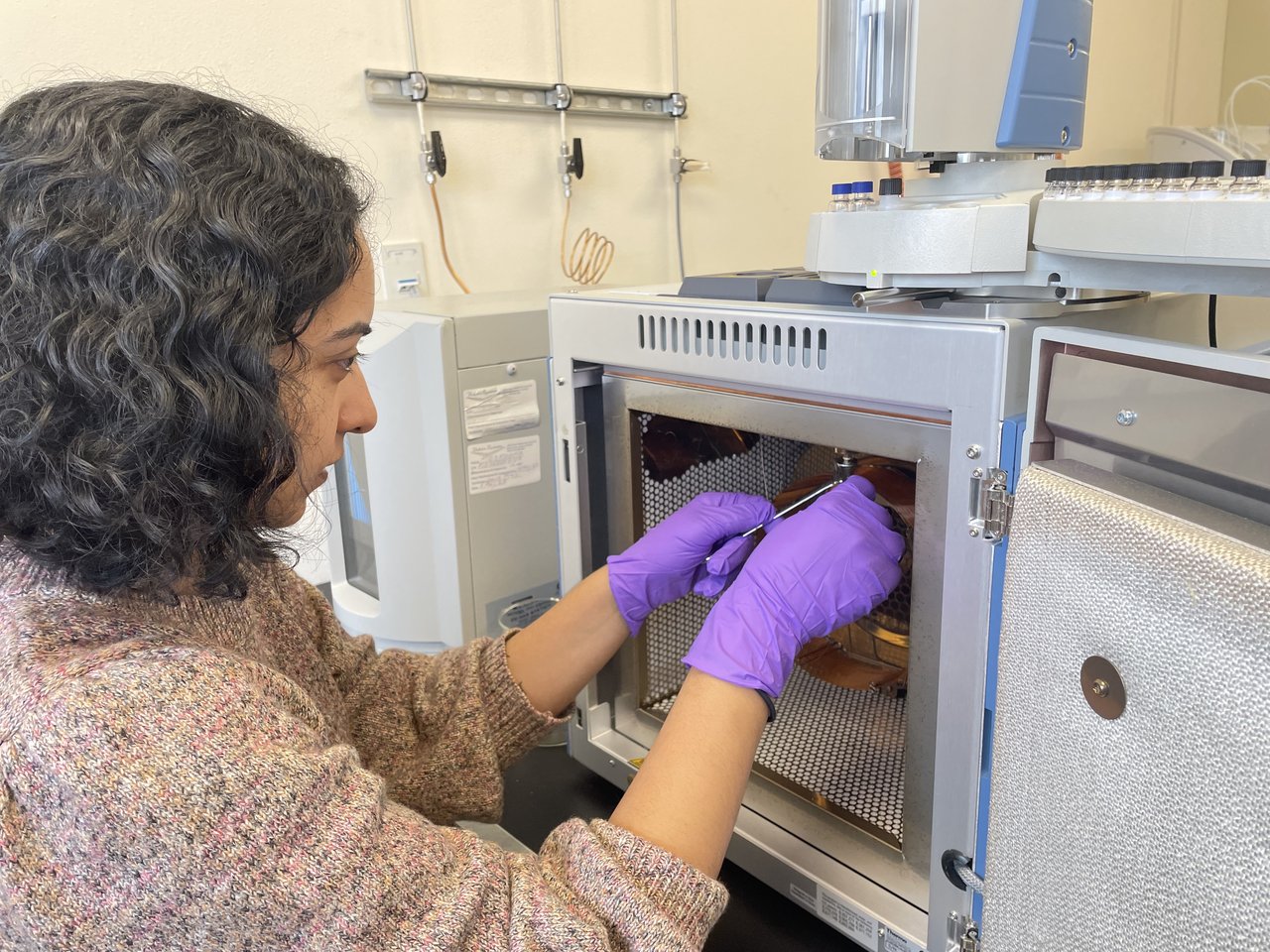
Bhattacharya’s research focuses on extracting climate information from fossilized leaf wax preserved in ancient sediments. Using specialized laboratory techniques, she isolates the hydrophobic outer coating of ancient leaves to measure hydrogen isotope ratios, which reflect how much rain fell and when it occurred. Because plants absorb rainwater during growth, the chemical signature locked in leaf wax serves as a powerful record of past precipitation patterns.
In the article, Bhattacharya explains how this method has revealed striking differences between past and present climate conditions. Her research found that during a period roughly three million years ago—when atmospheric carbon dioxide levels exceeded 400 parts per million, similar to today—southern California experienced rainy summers rather than the winter-dominated rainfall patterns seen now. This discovery helps scientists understand how warmer climate states reshaped ecosystems and supported tropical species in regions that no longer host them.
“Proxy data might seem like this obscure scientific thing, but it actually directly helps our efforts to manage climate risk,” Bhattacharya said in the article.
By connecting ancient climate behavior to modern conditions, Bhattacharya’s work provides critical context for forecasting how rainfall patterns, extreme weather and ecosystems may respond to ongoing climate change.
The Scientific American feature situates Bhattacharya’s work alongside other cutting-edge climate research that uses unconventional records ranging from seabird stomach oil to ostrich eggshells to fill gaps in Earth’s climate history. Together, these approaches allow scientists to use the past as an experiment, helping policymakers and communities prepare for future environmental change.
Published: May 8, 2026
Media Contact: asnews@syr.edu