
Caste Across Continents
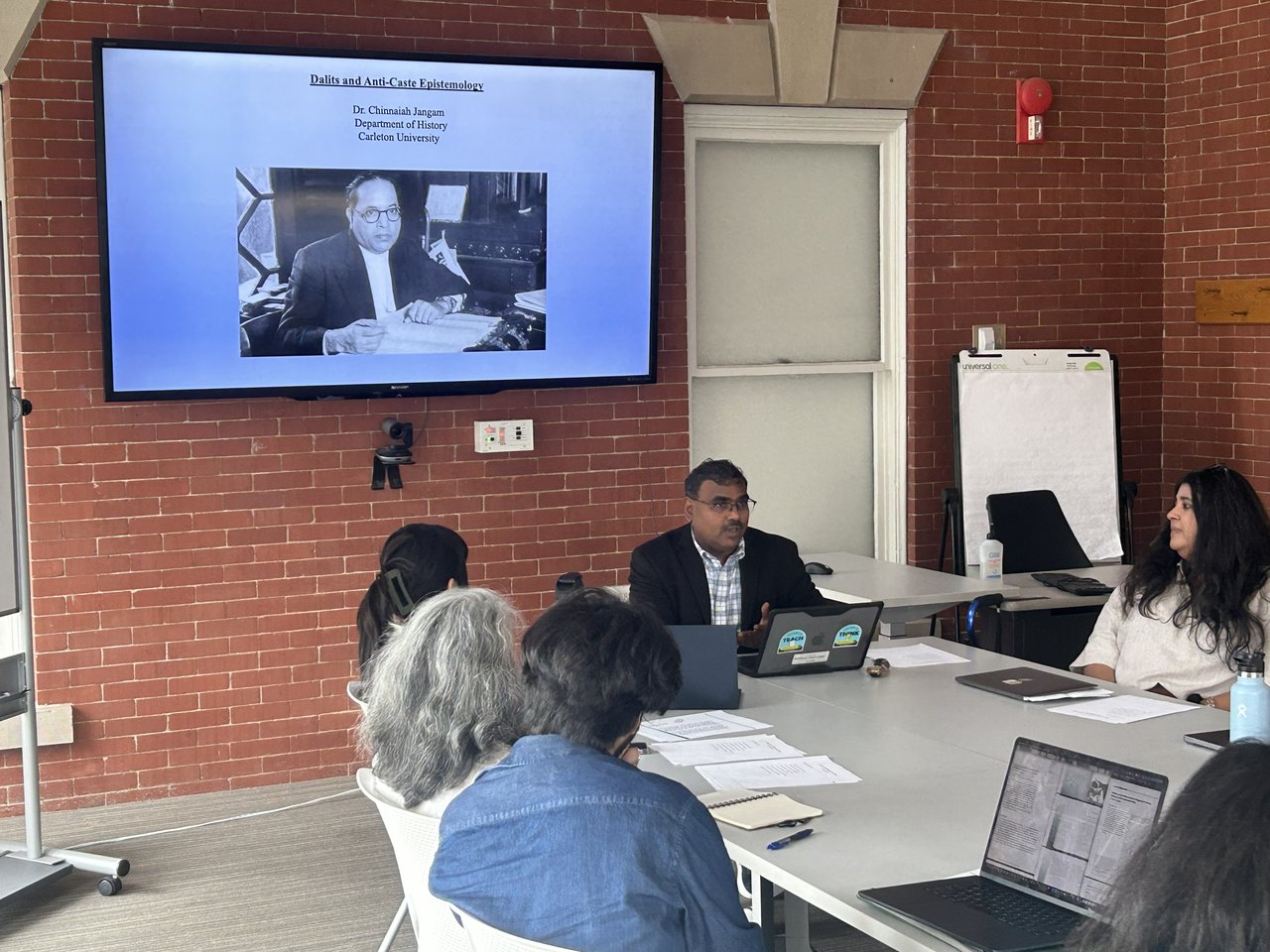
The Department of Women's and Gender Studies observed Dalit History Month again this April with a two-part program featuring Chinnaiah Jangam, associate professor of history at Carleton University in Ottawa. Hosted on April 14 and 15, the program included a workshop and a public lecture exploring the history and present of Dalit communities in North America.
Dalit History Month was established by civil rights activists, inspired by Black History Month, to commemorate the intellectual legacy, activism and lives of caste-oppressed people, communities historically labeled “untouchables.” Caste, a form of structural oppression originating in ancient India, divides people into categories at birth, and members of Dalit communities continue to face discrimination and violence both in South Asia and across the diaspora. The term “Dalit,” meaning “broken” or “oppressed,” was adopted as an act of political self-identification.
On April 14, Jangam led the "Anti-Caste Methodologies" workshop for graduate students and faculty in Sims Hall. The workshop explored approaches for writing history from anti-caste and critical-caste perspectives capable of countering dominant narratives.
A day later, Jangam delivered his public lecture, "Dalit Diaspora and Anti-Caste Movements in North America," at Watson Theater. He examined what it means to be a Dalit in North America and argued that the Dalit diaspora on the continent is as old as that of the Savarna (dominant-caste Hindu) diaspora. Drawing on stories of survival and resistance, he highlighted Dalit-led community mobilizations and social equity movements in the United States and Canada, and showed how intersectional solidarity with Muslims, Christians, LGBT+ communities and feminist alliances is reshaping diaspora identity politics.
Jangam is the author of Dalits and the Making of Modern India and translator of Gabbilam (Bat): A Dalit Epic, which received the Association for Asian Studies A.K. Ramanujan Prize for Translation in 2024. He co-founded the South Asia Dalit Adivasi Network (SADAN) in Canada, whose advocacy led the Toronto District School Board and the Ontario Human Rights Commission to address caste discrimination.
The events were organized by faculty members Himika Bhattacharya and Carmel Christy KJ of the Department of Women's and Gender Studies, with co-sponsorship from the Humanities Center, South Asia Center, LGBTQ Studies, History, CODE^SHIFT, English, Social Science Ph.D. Program, Engaged Humanities Network, Feminist Pedagogy Collective, the Dean's Office and the College of Arts and Sciences.
Published: May 5, 2026
Media Contact: asnews@syr.edu