
It All Begins with the Stick
Editor’s Note: The following article was written by Adam DJ Brett (G’22), an adjunct instructor in the College of Arts and Sciences’ Department of Religion and a public education and communications professional with the American Indian Law Alliance.
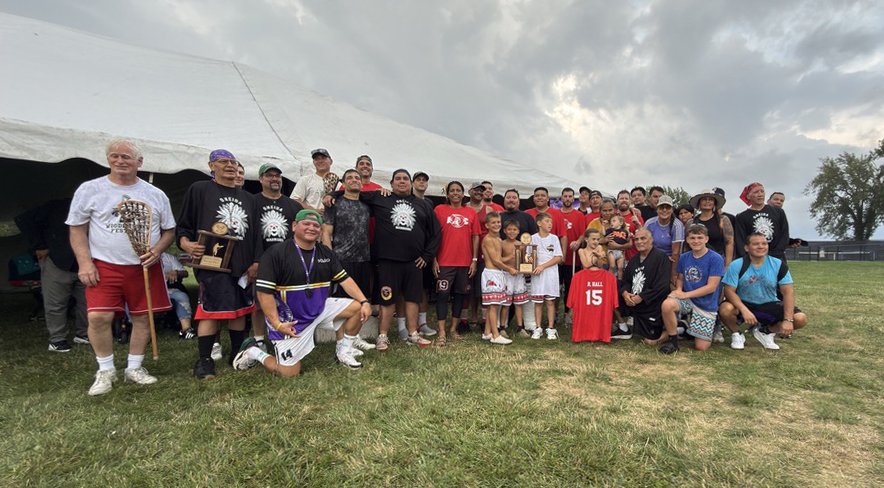
As a geek who loves Dungeons & Dragons and reading in the library, I never thought I would fall in love with sports, but I did. It happened while I was a Ph.D. student in Syracuse University's Department of Religion when I volunteered to help with the Haudenosaunee Wooden Stick Festival in 2016.
The festival was started by Philip P. Arnold, the Bishop W. Earl Ledden Professor of Religion in the College of Arts and Sciences (A&S), and his spouse Sandy Bigtree (Mohawk Nation). Randy Hall (Mohawk) had brought them a traditional lacrosse ball and told them they needed to help bring lacrosse back to Onondaga Lake and tell the stories of what the lake has given to the world, such as being the founding birthplace of American Democracy (as recognized by H.Con.Res.331 by the United States in 1988). It is also the birthplace of the women's movement, where the Creator's Game (lacrosse) was first played and, most importantly, where the Great Law of Peace was founded and the Haudenosaunee Confederacy was united.
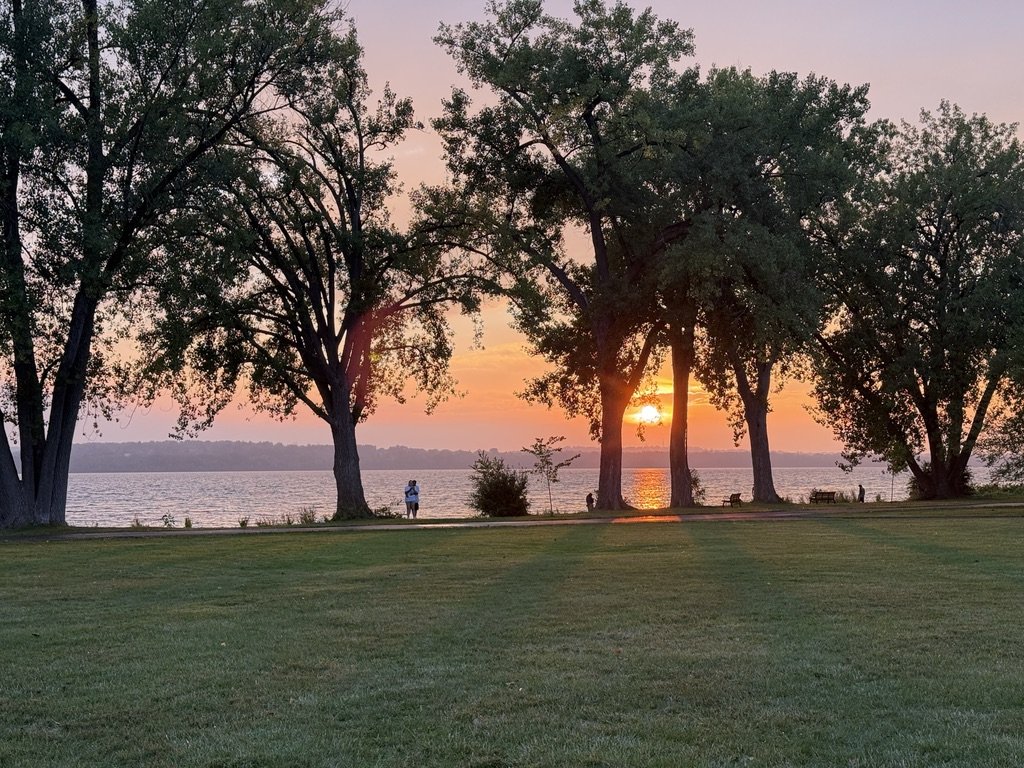
Every September, when the festival rolls around, it is one of the happiest times of my life, and it is my favorite event of the year. Going to the shores of Onondaga Lake to sit with the rough beauty of the sacred lake once pristine, now profaned. Here I am reminded of the duality of how Indigenous resilience and ecological flourishing reside alongside settler colonial extraction and pollution. Where celebrations of those who honor the Creator’s Game occur alongside trash pickup along the shores of Onondaga Lake. Where a lake that once nourished and sustained a region struggles against pollution, trash and raw sewage dumped into it, as people celebrate the lake and call for healing.
From Sept. 11 to 13, the American Indian Law Alliance (AILA) hosted the third annual Alfie Jacques Ambassador Award Dinner and the 11th annual Haudenosaunee Wooden Stick Festival, along with a community cleanup of Onondaga Lake. Volunteers from Onondaga Nation, Neighbors of Onondaga Nation (NOON), Le Moyne College, SUNY OCC, and Syracuse University spent the weekend helping with the festival. Speakers from Onondaga Nation, such as Jake Edwards (Eel Clan), discussed the Haudenosaunee wampum belts, and Ed Shenandoah (Wolf Clan) spoke about another important Haudenosaunee game, snow snake. General Counsel for Onondaga Nation, Joe Heath, told the story of Onondaga Lake and the Onondaga Nation land rights action, which now sits before the Organization of American States.
I spent the weekend helping AILA share the story of these events, and I want to share it here with the A&S community because what happened that weekend speaks directly to what we study and teach in the Department of Religion: religion, land, sovereignty, history and how communities carry meaning forward.
Honoring Alfie Jacques
The weekend opened Friday night with the Alfie Jacques Ambassador Award Dinner at Bellevue Country Club. The award honors Alfie Jacques, the Onondaga stickmaker who crafted wooden lacrosse sticks by hand for decades and died in 2023. As Inside Lacrosse founder Robert Carpenter, who helped establish the award, put it that evening: “There’s nobody like (Jacques). There will never be another person like him.”
This year’s honorees were Dom Starsia, the four-time national champion coach from Brown and Virginia; Michael Kennedy, the former captain of Ireland’s national team; and Mike Kanatakeron Mitchell, former Grand Chief of the Mohawk Council of Akwesasne, co-founder of the North American Indian Traveling College and founder of the Akwesasne Lacrosse Hall of Fame. They joined past recipients Sid Jamieson, Oren Lyons and longtime Syracuse coach Roy Simmons Jr., all six of whom gathered for a photo at the end of the night, a moment captured by The Daily Orange.
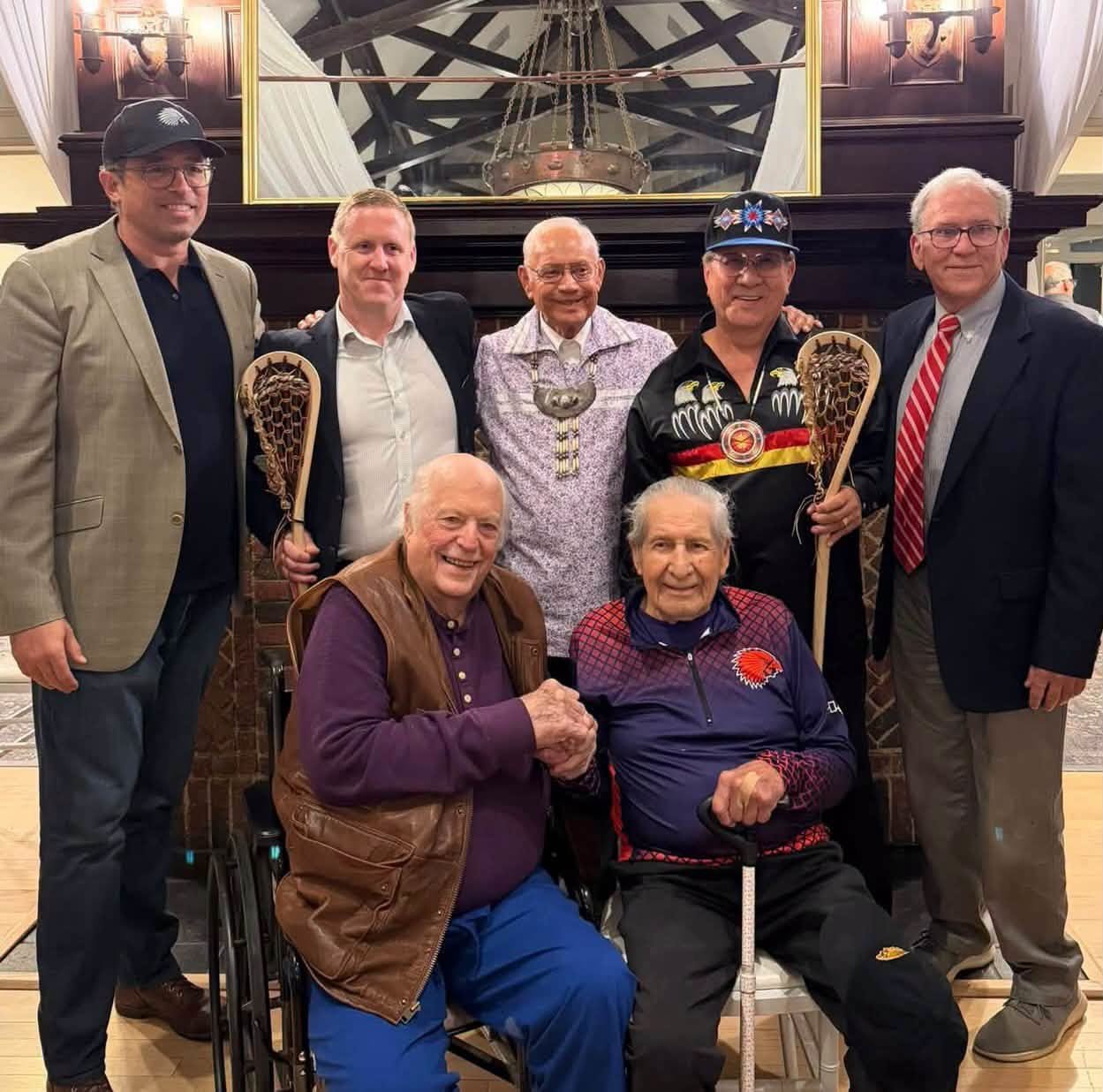
What struck me most was how each honoree, in his own way, returned to the power and importance of playing lacrosse with a good mind and wooden stick. Starsia remembered picking up lacrosse as a Brown freshman in 1970: “The feeling of the wood in my hands was magical.” Kennedy, whose voice nearly gave way as he described the Jacques-made stick his teammates gave him at retirement, said, “It all begins with the stick.” Mitchell reminded the room that, for the Haudenosaunee, the stick is part of life from beginning to end, placed in a child’s crib at birth and with a person at death. “Our people invented the game,” he said.
Each honoree received a wooden stick made by Jack Johnson (Mohawk), a mentee of Jacques who carries on his craft. Kennedy’s closing words have stayed with me: “We all have a responsibility to continue that cycle that Alfie has so generously passed on to us.”
Friendship Across Nations
Kennedy’s recognition is also a story about solidarity. In 2022, Ireland Lacrosse voluntarily gave up its place at the World Games in Birmingham, Alabama, so that the Haudenosaunee Nationals, representing the people who gave the world this game, could compete. Kennedy told the audience he considers it a responsibility to the game and has no regrets. What Ireland did is part of the gift economy that animates lacrosse. The Haudenosaunee and many other nations sent food to Ireland during the forced starvation of the Irish by the British during a period known euphemistically as the “potato famine.” Here, the Haudenosaunee and the Irish exchanged gifts upon gifts, giving up their place in line to one another, and, most importantly, Ireland honored and acknowledged the sovereignty of the Haudenosaunee Confederacy and their role as the founders of lacrosse, which they shared with the world as a gift from the Creator.
That friendship returned to the field on Sunday, when the Irish United team faced the Onondaga Red Hawks at the festival, The Daily Orange reported. With lacrosse returning to the Olympics at LA28, and the Onondaga Nation pressing for the Haudenosaunee to be included, Kennedy’s question to the room felt urgent: “If it is an Olympic sport, and the Haudenosaunee get excluded, is that really good for the sport?” The room gave a standing ovation for his support of the Haudenosaunee participating in the Olympics, marching under their own flag, traveling on their own passports, and playing their game.
The Medicine Game Returns to the Lake
On Saturday and Sunday, the Haudenosaunee Wooden Stick Festival filled Onondaga Lake Park with lacrosse, vendors, music, dancing and families. The festival’s centerpiece, the Randy Hall Memorial Master Lacrosse Tournament, asks players to set aside plastic and play with wooden sticks rooted in history. “Game's back, closer to the origins of the game,” player Shawn Langdon told WSYR.
Over more than ten games, five teams, including the Onondaga Red Hawks, the Oneida Silver Hawks, Irish United, and Mann’s Wolfpack Lacrosse Club, competed for a weekend championship. Many of these players have known each other since childhood. “We all sit together, we all eat together. It is very community organized,” said Oneida Silver Hawks player Tyler Gabriel in The Daily Orange.
Lacrosse is often called the “medicine game,” and Betty Lyons Hill (Onondaga Nation, Snipe Clan), AILA’s president and executive director and the festival’s coordinator, explained that the wooden stick itself holds medicine. “We’re trying to show that this game is about peace and friendship, that through this game, it can be healing and bring it back to why we’re here on the lake,” she said.
For me, the most moving moment of the weekend came during Sunday’s stick making demonstration. Betty’s 15-year-old son, Sidney Hill Jr. (Onondaga Nation, Snipe Clan), carved his first full lacrosse stick, drawing a knife along a length of curved wood while his mother watched and wiped away tears. “It feels like I’m holding a bit of tradition in my hands,” he told WSYR. Betty kept a coiled shaving from the carving, a way, she said, to keep the spirit of the wood with her.
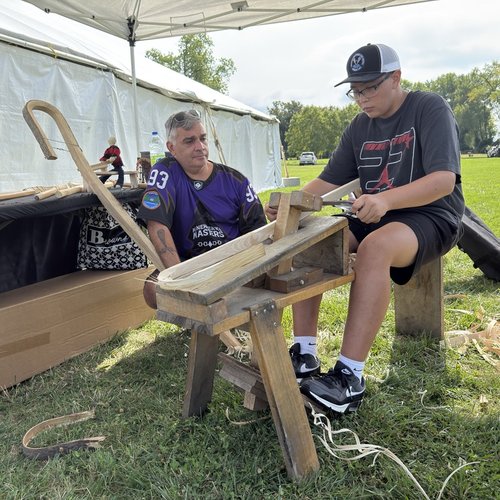
Travis Gabriel (Mohawk) (left) assists Sidney Hill Jr. (Onondaga) (right) as he carves his first full lacrosse stick, carrying forward generations of knowledge and craftsmanship associated with the Creator’s Game.
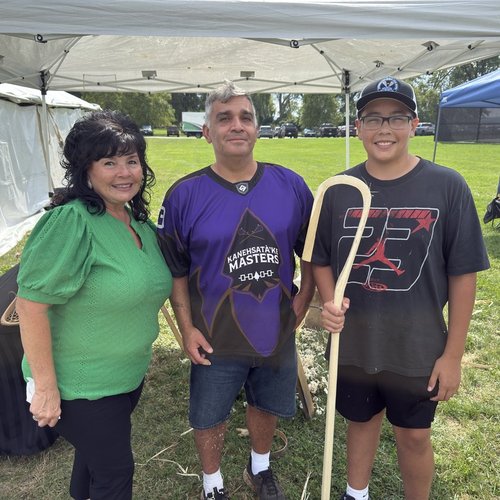
Betty Lyons Hill (left) with Travis Gabriel (center) and Betty’s son, Sidney Hill Jr. (right).
Around the fields, Haudenosaunee artists sold handwoven baskets, beadwork and jewelry, including carved elk bone pieces by Melissa McCann of the Onondaga Turtle Clan, as syracuse.com’s photo gallery captured. Children ran drills with small sticks of their own.
Caring for a Sacred Place
The festival is not only about the game; it is about the lake. In Haudenosaunee tradition, the Peacemaker brought the nations together under the Great Law of Peace there, and the lake has also endured generations of severe pollution. On Sunday, children and families walked the shoreline collecting trash, and Joe Heath, longtime counsel to the Onondaga Nation, spoke alongside the Skä•noñh Great Law of Peace Center about the lake's history and restoration.
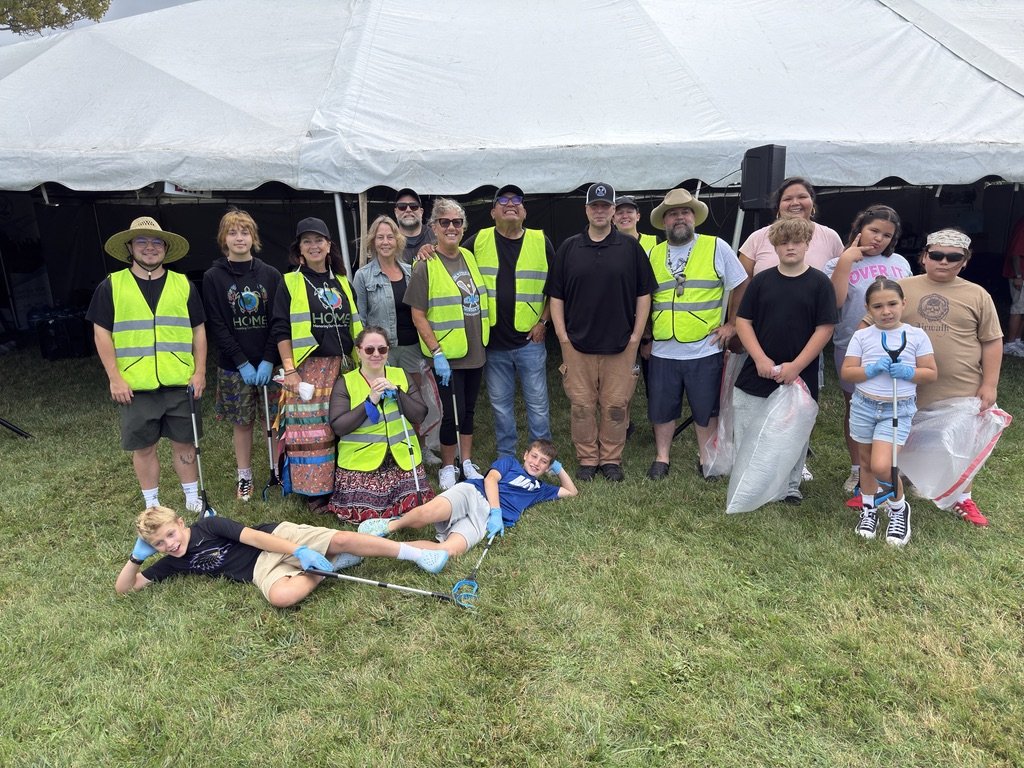
“People need to understand this should be important to everybody,” Betty said. She also reminded attendees that the Haudenosaunee remain a self-governing people: “Our own government still governs us. We are not U.S. citizens. And we are strong people. And I think that this event helps to demonstrate that.”
Why This Matters to Us
I am honored to teach religion at Syracuse University, and weekends like this one remind me that community and what Durkheim calls “collective effervescence” are not only found in texts and institutions. It lives in a stick placed in a newborn’s hands, in a game played to heal, in a promise to care for a lake, and in friendships between nations that choose to stand with one another. These living traditions of relationship and responsibility are happening a few miles from our campus.
Syracuse University sits on the ancestral lands of the Onondaga Nation, the central fire of the Haudenosaunee Confederacy. I encourage students, faculty, and staff across A&S to treat that acknowledgment not as a sentence read at the start of an event, but as an invitation to show up, listen and learn. Come to the festival next September. Pick up a bag and help clean the shoreline. Watch a wooden stick being carved and ask about the medicine it carries.
As Sidney Hill Jr. (Onondaga Nation Snipe Clan) put it: “We’ve been making these sticks for thousands of years, and just being able to hold that piece of tradition and culture is incredible.”
It all begins with the stick. What we do next is up to us.
Learn more about the Haudenosaunee Wooden Stick Festival and AILA’s work.
Published: Oct. 20, 2026
Media Contact: asnews@syr.edu