
The Evolution of Ethics
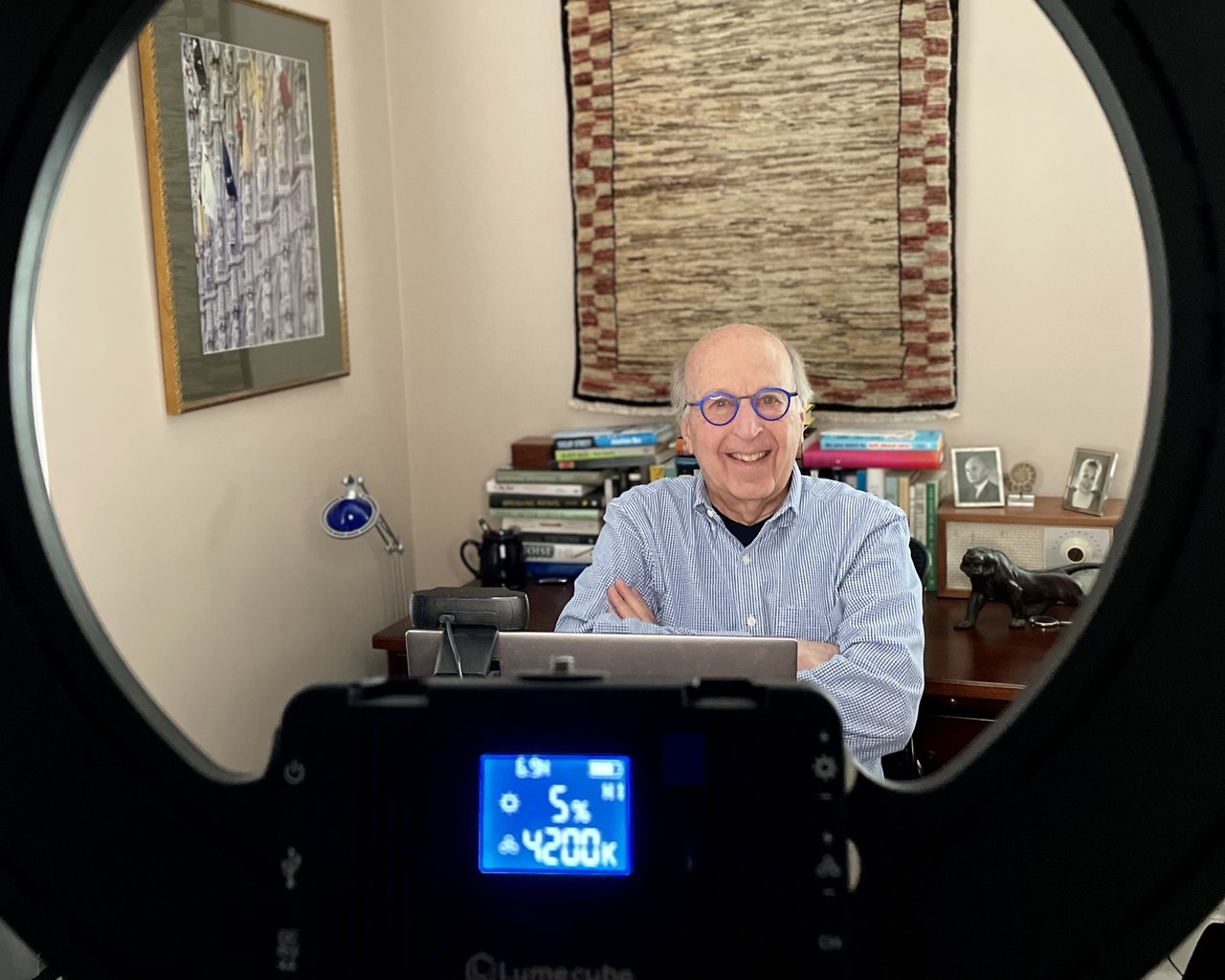
Samuel Gorovitz has spent more than half a century asking uncomfortable questions at the intersection of philosophy, medicine and public life. When he began his career in the 1960s, ethics was largely a theoretical pursuit — nuanced debates taking place away from the realities of human struggles. But medicine was changing rapidly. Organ transplantation, life-support technology, in vitro fertilization and genetic research were raising questions that no clinical guideline could answer, like who deserves scarce life-saving treatment and when does a physician's obligation to a patient end?
Gorovitz was among the first to argue that philosophy had not just a role but a responsibility in grappling with them. In a career spanning more than six decades, Gorovitz has testified before Congress, served on the New York State Task Force on Life and the Law, advised the World Health Organization and been recognized by the Johns Hopkins Berman Institute as a founding figure of bioethics.
After four decades of service to A&S, Gorovitz will retire at the end of this semester.
"We are deeply grateful to Sam Gorovitz for his seven years of leadership as dean of this College, and for a career in bioethics that has served not just A&S but the nation's conscience,” says Behzad Mortazavi, dean of the College of Arts and Sciences. “His work has defined the field, shaped federal policy and informed WHO guidelines. His institutional leadership and enduring public scholarship have benefited so many in A&S and beyond.”
Gorovitz, a Boston native, earned a B.S. at MIT and a Ph.D. in philosophy from Stanford University. He joined the faculty at Case Western Reserve University in 1964, where a conversation with a Nobel Prize-winning medical school dean set him on a path that would help define an entirely new field. He arrived at Syracuse University in 1986 as Dean of the College of Arts and Sciences (A&S), later became Founding Director of the Renée Crown University Honors Program, and has been a professor of philosophy in the College all along. His 10 books include Doctors' Dilemmas: Moral Conflict and Medical Care, the embedded hospital ethnography Drawing the Line: Life, Death, and Ethical Choices in an American Hospital and his most recent, Illuminating Philosophy: Stories Beyond Boundaries, published in 2023.
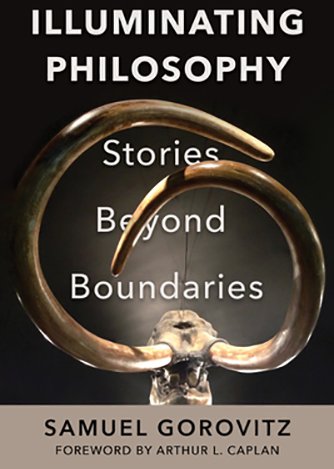
Gorovitz's 2023 book, “Illuminating Philosophy: Stories Beyond Boundaries.”
Gorovitz recently reflected on the field he helped build and the challenges it continues to face.
A 1962 LIFE magazine article about a Seattle dialysis committee was an early spark for your work in medical ethics. What was it about that story that impacted you so deeply?
Samuel Gorovitz (SG): Several things were converging for me at the time. I was finishing graduate school, working on scientific explanation and cause and effect, and separately thinking about decision-making under uncertainty. Then there was something unusual about how that story moved through the culture. Typically, an important discovery appears first in professional journals, works its way to something like Scientific American, and eventually reaches a general audience. But with the Seattle dialysis case, it worked in the opposite direction — a mass market magazine captured public attention first, and that pressure eventually prompted professionals to take the questions seriously. I found that fascinating. Here was an example of public attention creating pressure that made experts think in new ways about what was even worth thinking about.
And the question was who deserves life-saving treatment when there’s not enough to go around?
SG: Exactly. The doctors who developed dialysis at the University of Washington were saying, ‘Why are you asking us? We know about kidneys and filters and blood flow. We don't know anything about who's worth saving.’ That's not a medical or technical question. So then the question becomes: well, who should decide, and how? What attributes of a patient are actually relevant to that kind of selection? Those are philosophical questions. And I was sitting in a philosophy department at a university with a medical school, thinking — there's a tremendous amount of work to be done here and nobody has any idea how to do it.
In 1966 I walked across the street and made an appointment with the new dean of the medical school, a man named Fred Robbins. I told him I thought there were important ethical issues in medicine that weren't being adequately explored, and I asked if he'd be willing to help. He looked at me for a moment, then turned around, picked something up, and handed it to me. It was his gold Nobel Prize medal — he'd co-developed the vaccine against polio. But he said, ‘I had to do that work in Sweden, because I wasn't allowed to do it in the United States.’ The research involved fetal tissue, which was blocked on ethical grounds. He said he'd been wondering ever since, ‘If what I did was so valuable that it earned a Nobel Prize, why was it considered so wrong that I couldn't do it in my own country?’ Then he said, ‘I'll help you any way I can.’ In that moment, the dean of the medical school and a young assistant professor of philosophy became colleagues, collaborators and, eventually, very close friends.
You mentioned there was a lot of work to be done. What happened when you tried to get it out into the world?
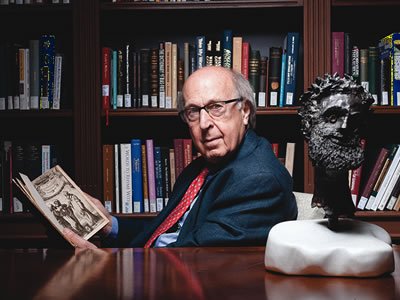
SG: I had between 12 and 15 rejection letters from publishers who kept saying the same thing: nobody's teaching medical ethics, there's no such field, don't send it. When I finally got Moral Problems in Medicine published by Prentice Hall in 1976, one year later the book had been adopted by 100 universities. That's when it became clear pedagogically. But the research side took longer. What I did, in part, was function as an accelerant. The Haverford seminar I ran in the summer of 1974 brought together faculty from across disciplines interested in exploring bioethical issues and pedagogy. They committed to going back to their institutions and teaching these questions. Years later, someone did a literature search and found over 500 bioethics articles written by people who had attended that summer. I didn't write those articles, but I helped catalyze the work.
How did moving between the academic and policy worlds throughout your career change how you think about ethical questions?
SG: There's an idea I've always found important, that medicine saved ethics from a sterile irrelevance. For a long time, academic ethics was very pure — careful, nuanced discussions with no real connection to what people were actually experiencing. What bioethics did was force a connectedness between scholarly work and what people truly care about in their lives. I remember drafting testimony for Al Gore's subcommittee and bringing the draft to my graduate seminar to critique and anticipate what questions Congress might ask. We'd revise it after the testimony and it would become a published article.
You came to Syracuse in 1986 as Dean of this College and have been here ever since. What has Syracuse and A&S given you intellectually?
SG: It gave me colleagues. Cathryn Newton — who became dean after me and served eight years, longer than anyone else — is a world-famous oceanographer and paleontologist who cares as deeply as I do about the connectedness between serious scholarship and what people actually need from an education. That kind of colleague shapes you. The students here have shaped me too. I've always believed my job in the classroom is to listen first — to understand what a student is actually asking before I try to answer it. You can't do that if you're in a hurry to perform.
Over your career, how well do you think academic ethics has kept pace with the moral questions that medicine and science keep generating?
SG: We're always running late, and we're always trying to show up early. You can't react to something that hasn't happened yet, but you can try to anticipate what's emerging. I've been getting inquiries lately about designer babies, about cloning, about the ethics of diagnostic algorithms. Some of that is reacting to what people are already doing. Some of it is trying to get ahead of what might happen and probably should be anticipated. Both matter. The field has never been static, and it can't afford to be.
Published: April 28, 2026
Media Contact: asnews@syr.edu