
Student Exhibition to Honor Veterans
The effects of war are not only felt by soldiers but also alter the lives of their families and communities, sometimes for generations.
Art can play an important role in how the wider public understands these experiences. Representations of war, battles and veterans — in sculptures, paintings, photographs and film — influence how people think about conflicts long after the fighting ends. During the Civil War, illustrations published in nationally distributed magazines molded understandings of the war, soldiers and the homecomings of veterans. The Vietnam War played out nightly on television screens and in mass media, as photographs of combat brought the war to American living rooms.
This fall, students in HOA 498: Art History Senior Seminar, taught by Associate Professor and Director of Undergraduate Studies in Art History Sascha Scott, are exploring that question: how has art framed the way Americans understand war, veterans and their families? What they uncover will take the form of a public exhibition, which the students are curating themselves for the Syracuse University Art Museum and which will open in March 2027.
“Syracuse University has a long commitment to veterans, dating back to the post-World War II era, when it welcomed thousands of returning GIs, and continuing today through the Institute for Veterans and Military Families,” says Emily Dittman, director of the Syracuse University Art Museum. “An exhibition on how artists represent veterans and their families builds on that legacy by asking who gets seen, and how. Including families widens the story to those who wait, support, and carry the long aftermath of service.”
Artists to be Featured in the Exhibition
- Winslow Homer — American artist known for Civil War (1861–1865) illustrations
- Alan Dunn — New Yorker cartoonist working during World War II (1939–1945), whose personal papers are held in Syracuse University’s Special Collections Research Center
- Associated Press and ACME — photographers who documented U.S. involvement in Vietnam (1964–1975)
- Stacy Pearsall — Syracuse University alumna and combat photographer active during the Iraq War (2003–2011)
“The United States has been at war all but 15 to 20 years of its existence as a nation,” Scott says. “The students and I aim to amplify the impact war has had both on those who serve and on their families.”
Samples of Art to be Featured in the Exhibition
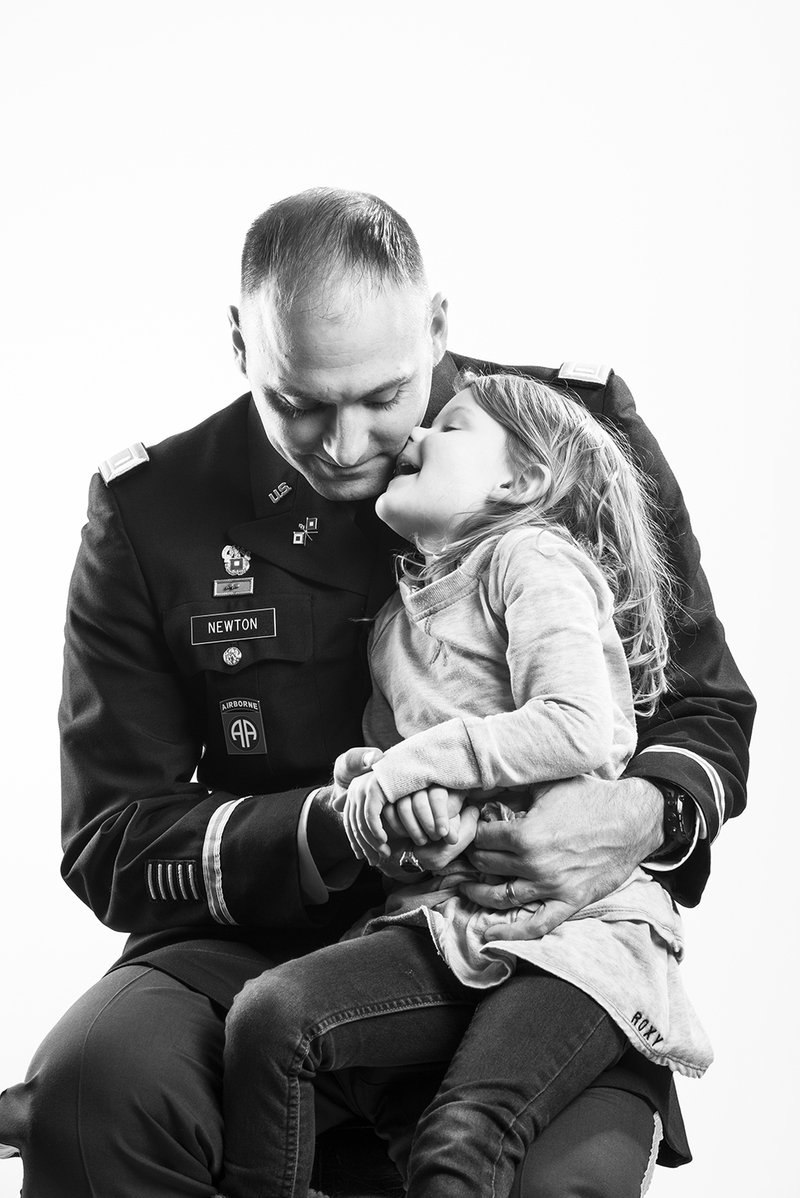
Martin K .Newton, 2013. Stacy Pearsall (American, born 1980). Archival pigment print. Gift of the artist. 2013.0236
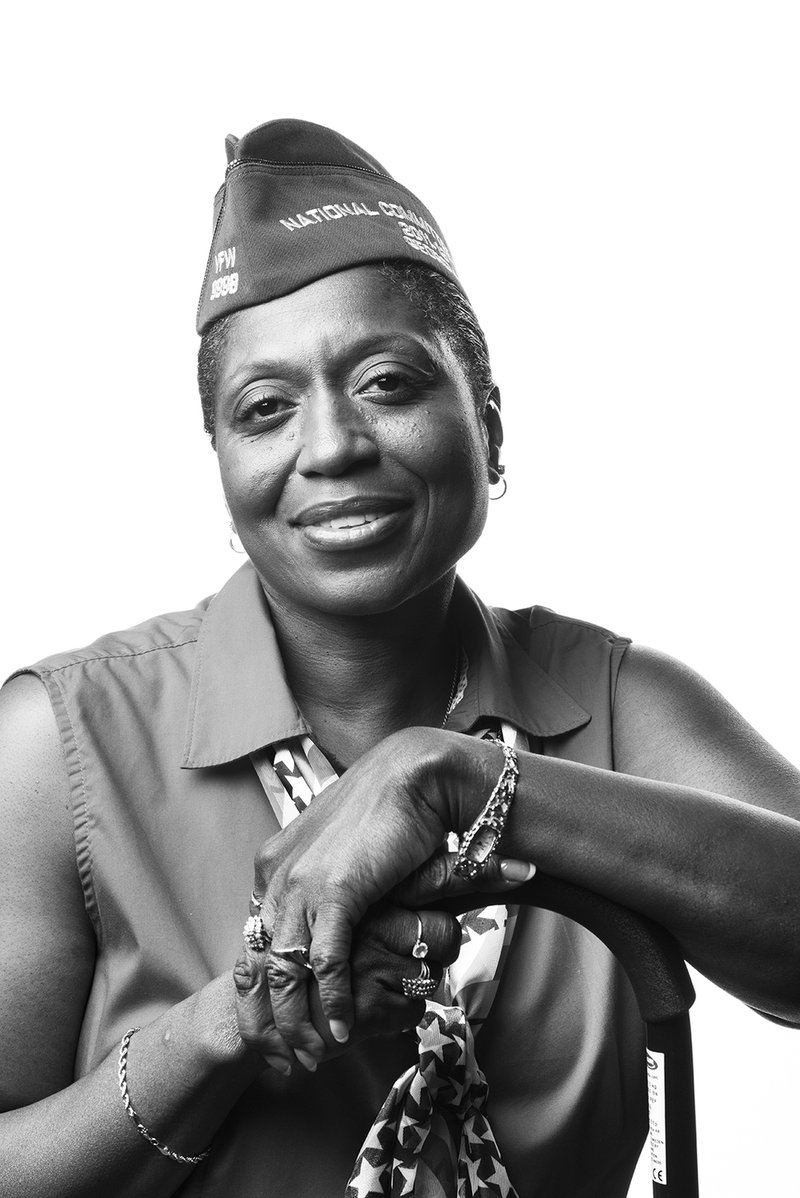
Robin Robinson, 2013, printed 2015. Stacy Pearsall (American, born 1980). Archival pigment print. Gift of the artist. 2016.0043
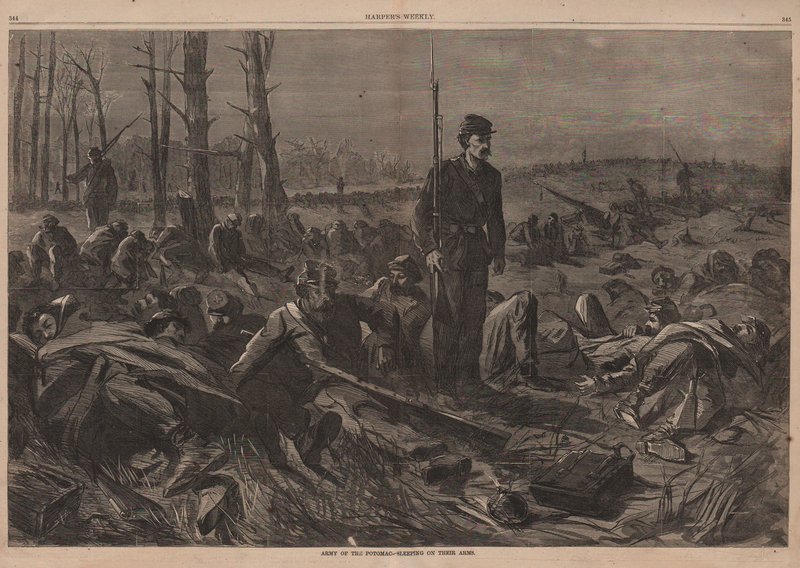
Army of the Potomac - Sleeping on their Arms, 1864. Winslow Homer (American, 1936 - 1910). Wood engraving. Museum purchase. 2013.0013
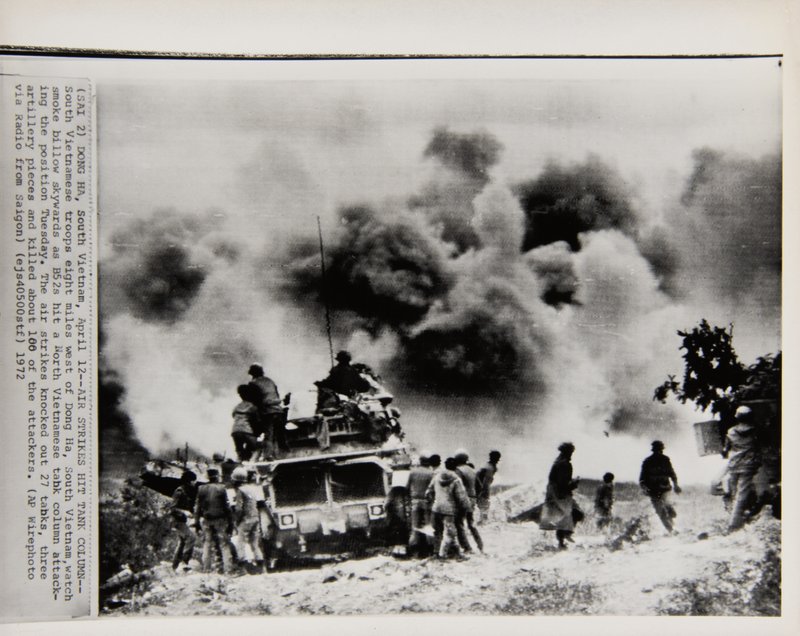
Air Strikes Hit Tank Column, April 1972. Nick Ut (Vietnamese, born 1951), Associated Press (AP) (American, founded 1846). Gelatin silver print. Gift of Jonathan Ungar. 2026.51
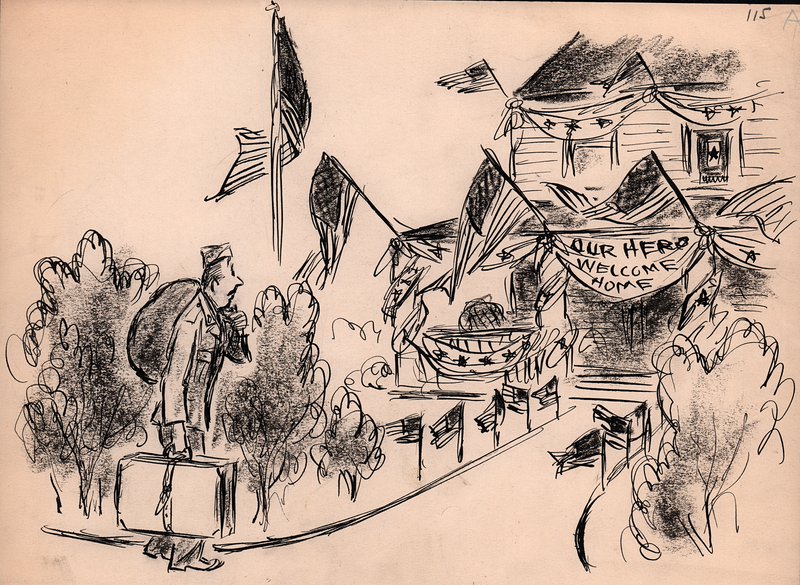
[Soldier returning home to house covered with flags and banners], 1945. Alan Dunn (American, 1900 - 1974). Crayon and ink. Mary Petty and Alan Dunn Bequest. 1979.2116
A Capstone Built on Curation
Each year, art history faculty in the Department of Art and Music Histories lead senior students through a semester-long project to create an art exhibition for the Syracuse University Art Museum. The course is both a capstone research and writing class and a hands-on apprenticeship in the kind of public-facing work many art historians do every day.
Their research on the Civil War and World War II brought them to Syracuse University's Special Collections Research Center to consult archival materials and artists’ personal papers. Their work on the Vietnam War and post-9/11 conflicts (Operation Enduring Freedom and the Iraq War) has been enriched by four guest speakers.
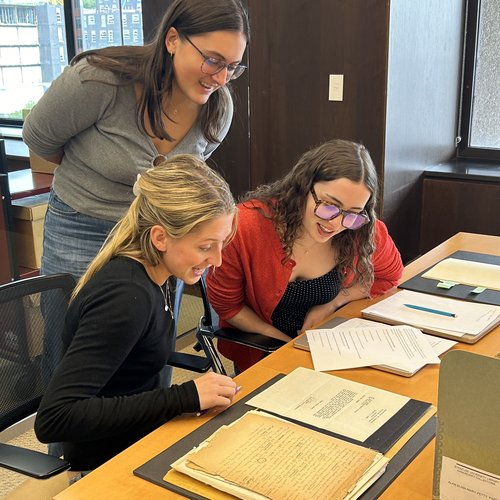
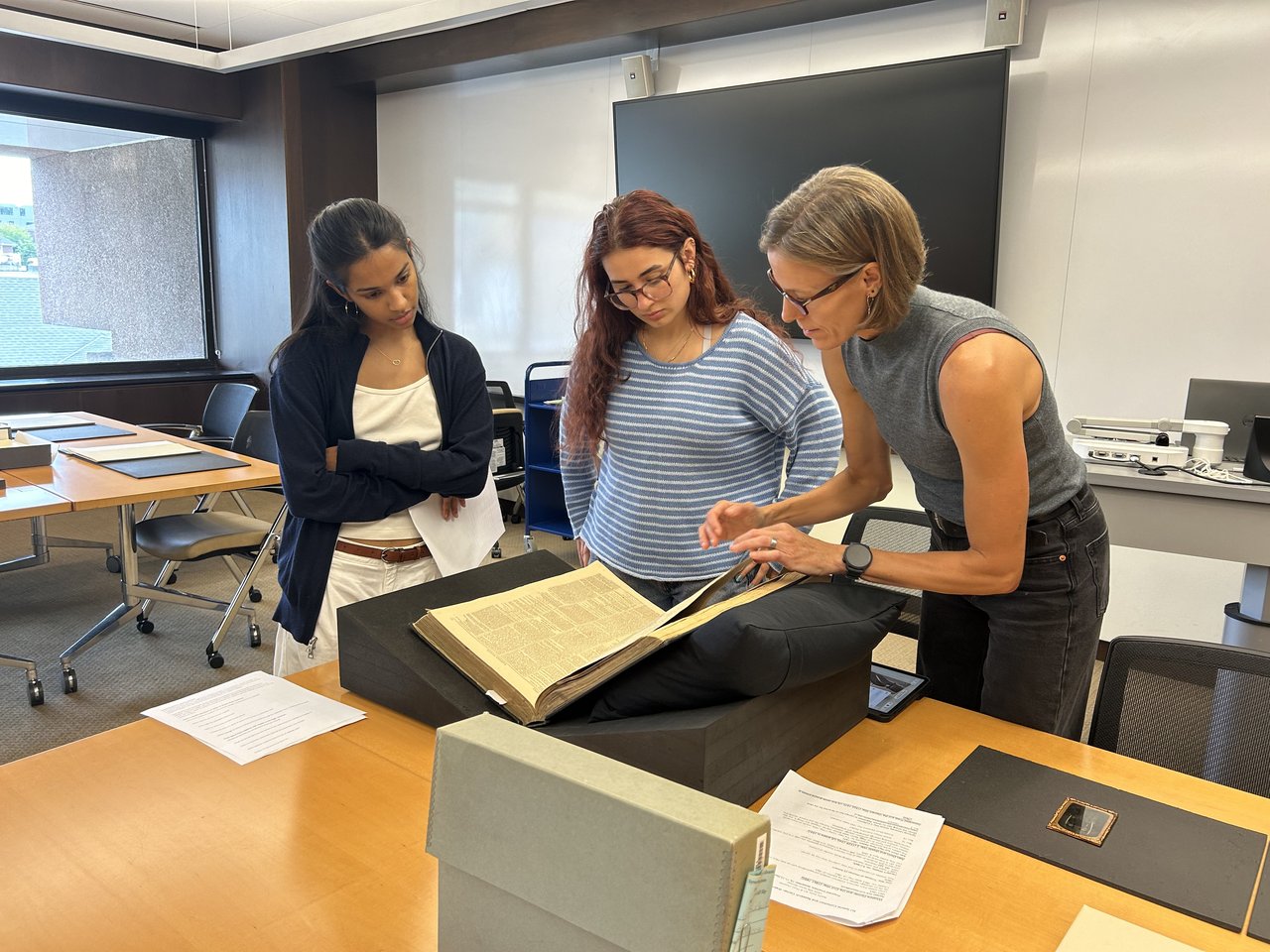
Students enjoy reviewing archival materials at Syracuse University's Special Collections Research Center.
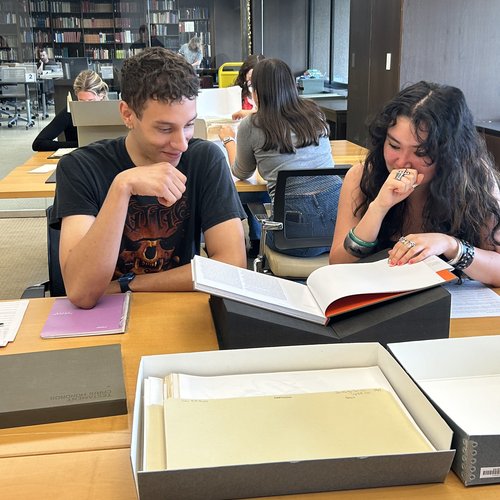
In September, class was held in the University's Special Collections Research Center to consult archival materials and artists’ personal papers.
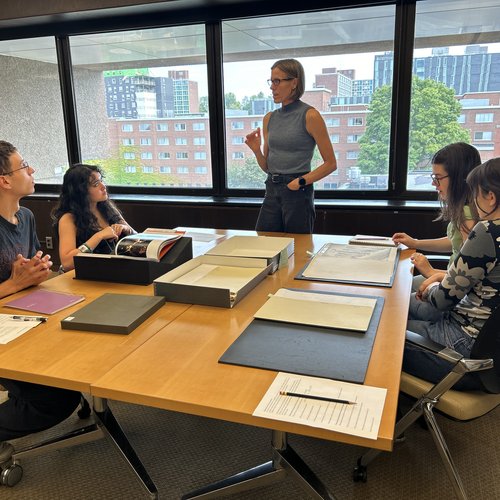
Scott speaks with a group of students during class at the Special Collections Research Center in Bird Library.
“What makes this project so special, and something very few academic programs offer, is that the capstone lets students do the work of a curator from start to finish,” Dittman says. “They select objects, research them, write labels, and develop initial proposals for the installation and public programming, making real curatorial decisions that visitors will see.”
Learning From Those Who Served
To help students approach this complex topic with sensitivity and empathy, Scott invited four veterans whose diverse experiences touch on many aspects of military-connected lives.
Bill Cross, a Syracuse University alumnus who served 10 years in the Army, including combat duty in Vietnam, spoke with students about working with veterans, first responders and their families as a licensed marriage and family therapist. After his service, Cross built an academic career spanning multiple institutions — earning degrees from West Point and Syracuse University, teaching psychology and leadership at West Point, and later serving as professor emeritus of psychology at Onondaga Community College, where he won the Chancellor’s Award for Excellence in Teaching.
Stacy Pearsall, an SU alumna and award-winning combat photographer who began her Air Force career at 17, shared the story behind her Veterans Portrait Project, which has photographed more than 8,500 veterans nationwide and has been shown at the Smithsonian and other prominent institutions. Pearsall completed three combat tours in Iraq, earning the Bronze Star Medal and two Air Force Commendation Medals with Valor. After studying photojournalism at Syracuse University’s Newhouse School, her own recovery from service-related injuries led her to found the Emmy Award-winning Veterans Portrait Project in 2008.
Colonel (Ret.) Meghan B. Doherty, who flew more than 3,900 hours as an Air Force Command Pilot over a 27-year career, and Colonel Michael S. Doherty, an Air Force intelligence and cyberspace officer currently serving as Deputy Chief of Sensor and Data Operations at the National Security Agency, both spoke to the class about their careers. Meghan, Scott’s identical twin sister, and her husband Michael, also discussed being career officers and the impact combat deployments have had on their family of six.
“The students and I are deeply grateful to these four distinguished veterans for sharing their time, insights and experiences,” Scott says. “Our conversation not only deepened our understanding of complex themes such as reintegration, but also enriched the ways we interpreted and engaged with the artworks in the exhibition.”
The speakers were supported by a gift from John ’66 and Eleanor ’69 Hopkins. In addition, the Hopkins gift supported a professional development dinner with alumni who work at the Everson Museum of Art. It will also support a public reception and lecture that will cap off the exhibition’s run in the spring. Perhaps most importantly for the exhibition, the fund also made possible the paid positions for two graduate student researchers — Nasdja Wilson, a New York Army National Guard veteran pursuing an M.A. in museum studies, and Elise Provident, an M.A. student in art history.
Wilson, who worked alongside the seniors to help create the exhibition, has found the experience meaningful. “As a veteran, I find it difficult to find spaces where the military and visual arts can intermingle, so contributing to this project has been inspiring in many ways,” she says. “I am developing hands-on experience and museum-related skills that will help me succeed in this field in the future, while also improving my creative eye for my own works of art!”
A Hands-On Approach to Art History
Scott works alongside her students as part of a curatorial team, rather than lecturing them. "I give them all the background readings, but we come together and talk about it," she says. "I pick the works, but they pick the title of the exhibition. They write all the wall text. The students shape the project."
This course is built around a specific philosophy of what art history training should look like. "Art history is public humanities," Scott says. "Everything we do has to be legible to a public audience. We're teaching students that they're not writing for their professors — as art historians we are often writing for the public."
In October, students traveled to New York City for a four-day trip. Thanks to support from The Mirken Practicum Fund in the College of Arts and Sciences, they met with arts professionals, including at museums, galleries and auction houses.
In the spring, after the exhibition opens, students have the option to give a public talk about their research — something Scott says nearly every student chooses to do, even though it's not required. This exhibition opens March 15 and runs through graduation weekend in May.
“Curating an exhibition in the Art History Senior Seminar course this fall has been an amazing collaborative experience with fellow art history seniors, Professor Scott, and staff at the SU Art Museum and Special Collections Research Center,” says art history major Natalie Becue ’27. “Especially in such a digital age, engaging in hands-on research with primary sources in the museum and SU Archives has been an incredibly unique and rewarding opportunity.”
For the students building it and the visitors who will walk through it in the spring, the exhibition will offer an invitation to look closely at how art has framed the way we understand war.
Published: Nov. 20, 2026
Media Contact: asnews@syr.edu