
Shakespeare in the Present Tense
Think of the last film or play you saw. Were you riveted to your seat, following the action unfolding in front of you? When the lights came up, did the story and characters stay with you, offering a new way of thinking about something? Storytelling—on the page or on the stage—has long connected people across circumstance, time and place, bridging divides and building understanding.
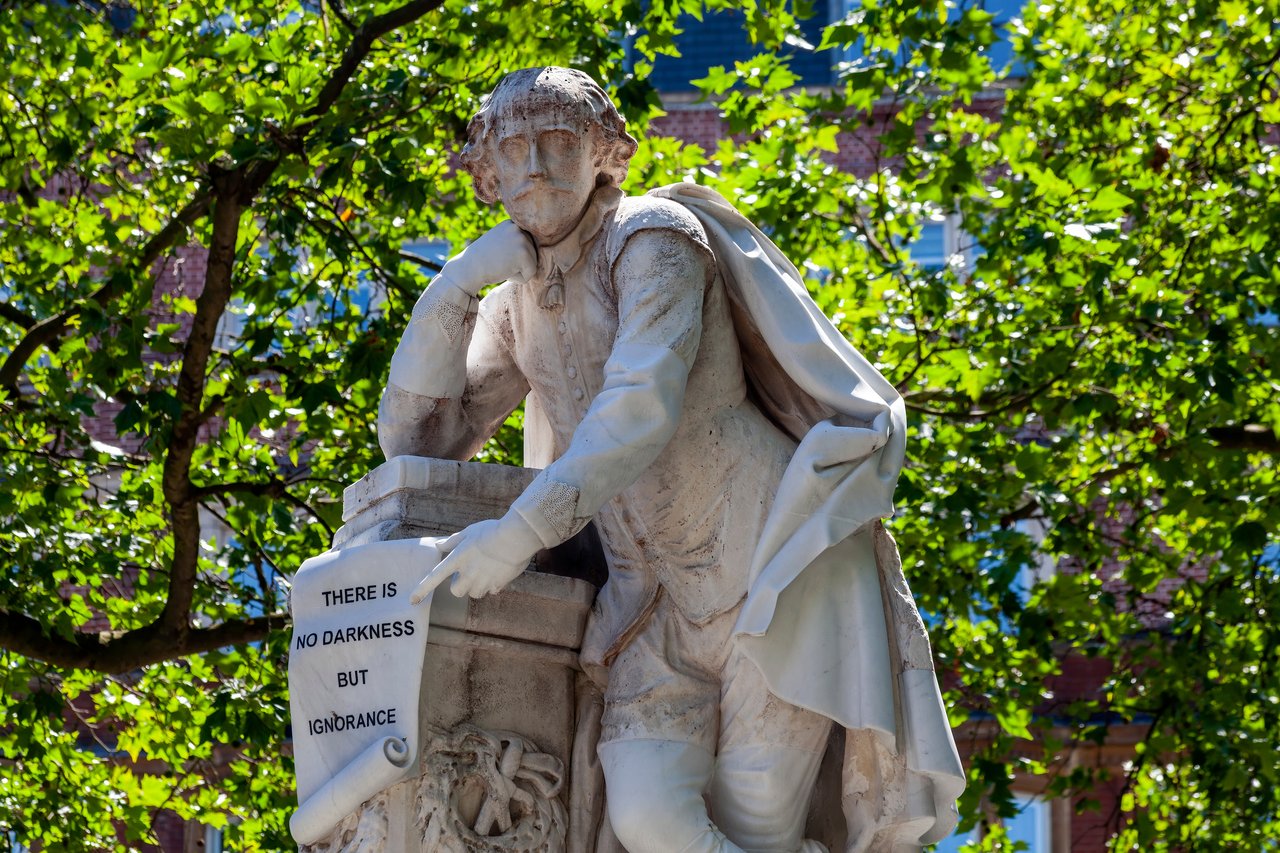
Few writers have sustained that power more enduringly than Shakespeare. From the stage to the classroom, his plays continue to be reimagined in ways that speak to the present moment—a process explored by Dympna Callaghan, University Professor, the William L. Safire Professor of Modern Letters, and a leading scholar of Shakespeare and early modern literature. She recently co-edited Shakespeare and the Poetics and Politics of Relevance: Gender, Race, Ecology (2024) and joins us to discuss why Shakespeare still matters today.
Shakespeare keeps resurfacing in contemporary culture and is often described as “timeless.” Your research suggests something more dynamic—that each generation finds new meanings in the plays. Why does Shakespeare continue to invite reinterpretation across time?

Dympna Callaghan (DC): Shakespeare knew how to pick a story. Most of his plots are not original—they come from Italian novellas or Ovid’s Metamorphoses—but he does incredible things with them. In that sense, modern reinterpretations continue a tradition of which Shakespeare himself was a part. His plays are already adaptations, and they inspire people to make them speak to their own moment.
It’s also interesting that Shakespeare gets quoted by people across the political spectrum. Unlike novels, plays don’t have a single authorial point of view. They present different voices and perspectives, leaving a great deal open to interpretation. Because plays depend so much on performance, every staging becomes a new iteration of the work. Audiences bring their own concerns and experiences to it, so the plays keep being rediscovered in different ways.
You’re currently teaching both Hamlet and Hamnet, Maggie O’Farrell’s novel about Shakespeare’s family. What happens when students encounter the play alongside this modern reimagining of the world around it?
DC: Shakespeare didn’t write anything specifically about the death of his only son, Hamnet, at age eleven. Or, if he did, it hasn’t survived. O’Farrell’s novel—and its recent film adaptation—fill in a gap by exploring what this loss was like. That’s very inventive and has inspired some of my creative writing and film students to use Shakespeare as a springboard for their own work.
The Backstory: Who was Hamnet Shakespeare?
Hamnet Shakespeare (1585–1596) was the only son of William Shakespeare and Anne Hathaway, born in Stratford-upon-Avon alongside his twin sister, Judith. The impact of the boy’s death at age 11—the cause remains unknown—on Shakespeare’s work has long been debated, particularly whether it influenced Hamlet, written a few years later. He has also appeared in popular culture, most notably in Maggie O’Farrell’s novel Hamnet and its 2025 film adaptation.
I think the novel draws out something that’s already inherent in the play, which is this business of grief and mourning. Hamlet is very much about how we deal with mortality and the dead living among us in vivid ways. Hamlet doesn’t really get to grieve properly for his father. He’s told to stop mourning by Claudius and his mother, and that unresolved grief drives the play. What Hamnet does is creatively extrapolate those ideas around Shakespeare’s life. It contains a beautiful piece of writing about how the plague was carried from a foreign shore back to England by a monkey, which students find fascinating. They’re also interested in notions of witchcraft present in the book. But interestingly, they still tend to prefer the play, which I’m pleased about.
In recent years, scholars have increasingly connected Shakespeare’s plays to conversations about race, gender, and the environment. Why do these questions feel especially pressing in Shakespeare studies today?
DC: In A Midsummer Night’s Dream, Titania describes how the natural world and the seasons have suddenly fallen out of order, with contagious fogs, floods, and failing crops. When we hear those lines today, it’s hard not to think about climate change. It feels prescient now, almost uncanny. But I’m not suggesting you can draw a simple analogy between Shakespeare’s texts and the modern world. As readers, we bring our own concerns to the plays. It’s not a passive engagement.
How do those concerns shape the way we think about gender in Shakespeare’s work?
DC: Notions of gender in Shakespeare’s time derived not only from the Bible but—through the rise of humanism and the Renaissance turn to classical culture—from Ovid’s Metamorphoses, where characters frequently switch from one sex to another. Many of Shakespeare’s stories and those of other literary writers of that time dealt with some form of gender transformation. We see this clearly in Twelfth Night, where Viola dons male attire. Shakespeare is also playing with the reality that in early modern theater, women weren’t allowed on the stage, so female roles were performed by boys. In a way, an early modern trans culture was already built into the theater—suggesting that ideas about gender were more fluid than we might imagine. That started to be increasingly relevant to our own debates about gender identity. Just recently, the great British actor Sir Ian McKellen introduced a trans and non-binary production of Twelfth Night in London.
And what about race—how do those questions come into focus?
DC: Race is not only important in Othello or Titus Andronicus, where racial difference is central to the story. Shakespeare’s language often relies on color imagery. In the sonnets, for example, the young male beloved is repeatedly described as “fair,” while the woman in the later poems is described as “black” or “colored ill.” Those terms don’t necessarily mean race in the way we understand it today. They could refer to complexion, hair color, or moral qualities, but they do create a kind of color coding. Race was not irrelevant to early modern people either. There were Black people living in Britain, so it’s not just a metaphor, but ideas of race were rather different.
In recent years, there’s been fascinating work by critics who have been motivated by their own concerns about race—books like Arthur Little’s White People in Shakespeare or Farah Karim-Cooper’s The Great White Bard. What’s interesting about these studies is that they show how Shakespeare can open up conversations about race that are not acrimonious, dogmatic, or ideologically inflected. The plays allow us to raise questions we might find too difficult to talk about elsewhere.
What can Shakespeare open up in those kinds of conversations?
DC: We’re all incredibly different and need some common cultural ground. You can see that historically as well. During the American Civil War, people turned to Shakespeare—especially Hamlet and Julius Caesar—to process the tragedy that was happening around them. I think it’s wonderful when everybody is focused on a particular cultural moment, the way we are right now with Hamnet.
What continues to surprise you about Shakespeare, after so many years of studying and teaching his work?
DC: I’m surprised every time I see a performance. I recently saw a production of Othello in London that staged Desdemona’s death quite differently—it made the familiar shocking again. And then there’s the language itself. I find the beauty of Shakespeare’s poetry increasingly moving the older I get.
Published: April 21, 2026
Media Contact: asnews@syr.edu