
A “Lost” Portrait Found
From social media to television, popular culture is saturated with images of the rich and famous. But long before TV and the internet, portraiture elevated certain individuals while erasing others, promoting hierarchies of wealth, privilege and power. Exemplifying this historic trend in European art is a portrait titled Tuccia, the Vestal Virgin (1786) in the collections of the Syracuse University Art Museum.
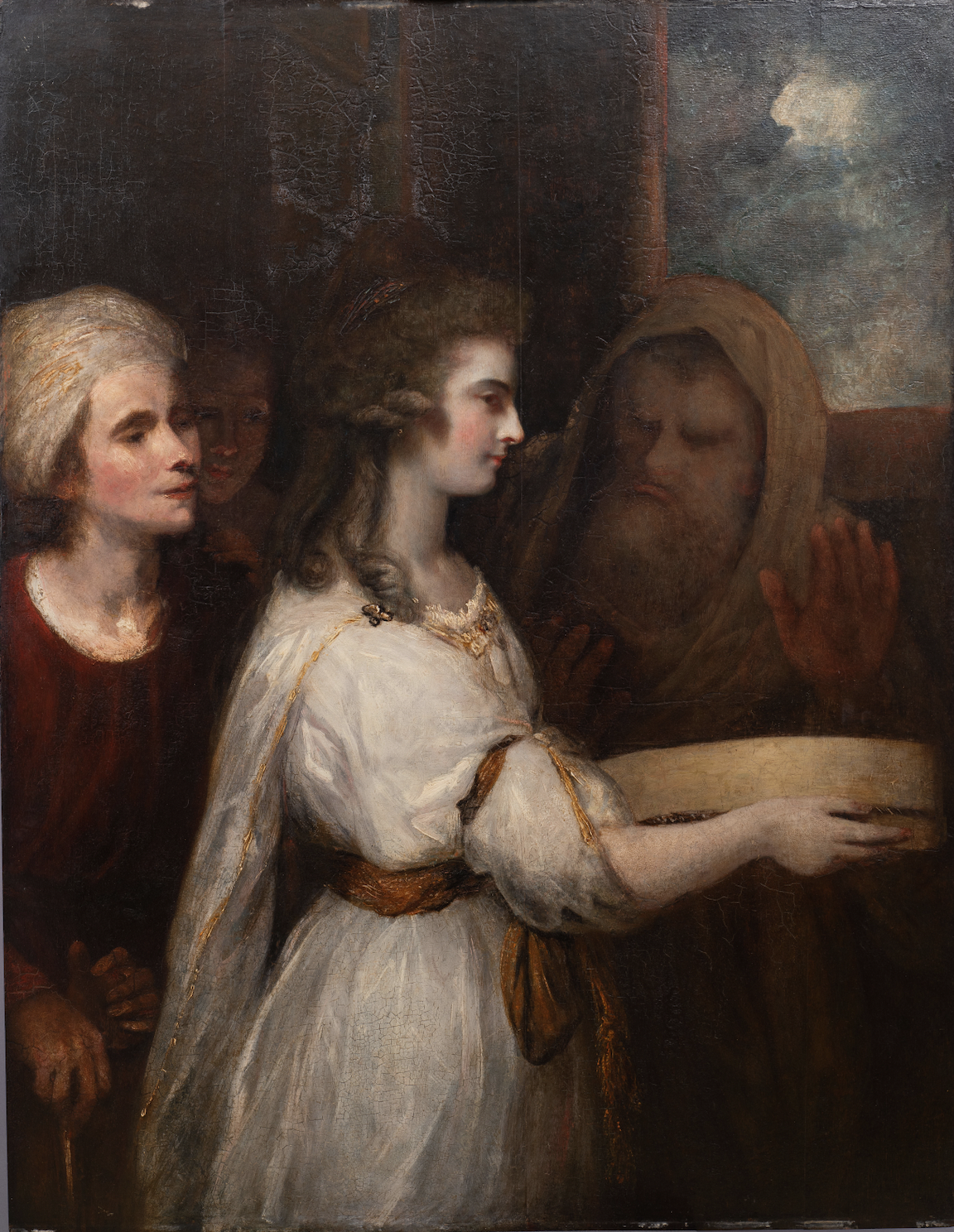
Recently cleaned and restored, the painting was made by Sir Joshua Reynolds (1723-1792), the first president of the Royal Academy of Arts in London and the leading British portrait painter of his time. On view at the museum for the first time in five decades, as part of the exhibition "Human/Environment: 4,000 Years of Art" (through Spring 2029), the painting inspired this year's Ray Smith Symposium on the politics of portraiture.
Depicting Rebecca Lyne (Mrs. Seaforth) as Tuccia, a Vestal Virgin, the image represents Reynolds’s reliance on Classical and Renaissance art to animate many of his portraits—an approach to portrait-painting that he advocated in his highly influential book Discourses on Art. Drawing upon the Vestal Virgins or priestesses of ancient Rome, Tuccia’s story highlights the virtue of chastity. However, Lyne was known to be the mistress of Richard Barwell, a powerful and wealthy East India Company merchant and administrator whose portrait Reynolds had also painted—making the decision to present her as a symbol of chastity an intriguing choice, notes Romita Ray, associate professor of art history at Syracuse University’s College of Arts and Sciences. Clothed in Bengal muslin—an Indian luxury—her face blushing with powdered rouge and her hair curled into ringlets, Lyne embodied the ideal of 18th-century British beauty.
“Her portrait was displayed for six consecutive exhibitions at Thomas Macklin's Poet's Gallery in London, talked about in the newspapers, then circulated widely as an engraving—functioning much like a viral image would today,” says Melissa Yuen, curator at the Syracuse University Art Museum.
Learn more about Reynolds’s Tuccia, The Vestal Virgin, in the video below.
The Portrait That Disappeared
Gifted to Syracuse University in 1968 by Theodore Newhouse, brother to Samuel Irving “S.I.” Newhouse Jr., the portrait was in storage for nearly 50 years and was long considered "missing" by leading Reynolds scholars. The rediscovery came in 2017 when Ray identified the painting in the museum's collection. Working with undergraduate research assistant Tammy Hong ’18 and museum staff, Ray confirmed the painting's authenticity.
“Curiosity led me to the painting while researching the museum’s collections of eighteenth-century art for my art history classes on European art,” says Ray. “Imagine my excitement when I stumbled on what was potentially a ‘lost’ portrait painted by Reynolds—and that too, one with such strong ties to East India Company history, one of my areas of specialization. It also presented an ideal opportunity for my undergraduate advisee Tammy Hong to dive into a fabulous research project.”
Yuen, who played a key role in the painting's conservation and research, says the Reynolds portrait is one of the most significant European paintings in the museum's collection. To better illuminate the painting’s story, Yuen located and acquired a 1796 print engraved by P.W. Tomkins of the original painting and arranged for the work's restoration at Westlake Art Conservation Center in Owasco, New York. There, conservator Raphael Shea removed layers of old varnish, revealing brighter colors and more vivid details, while also stabilizing the deteriorating gilded frame. Yuen also engaged with staff at the Duke of Roxburghe's collection at Floors Castle located in southeast Scotland to study another version of the portrait.
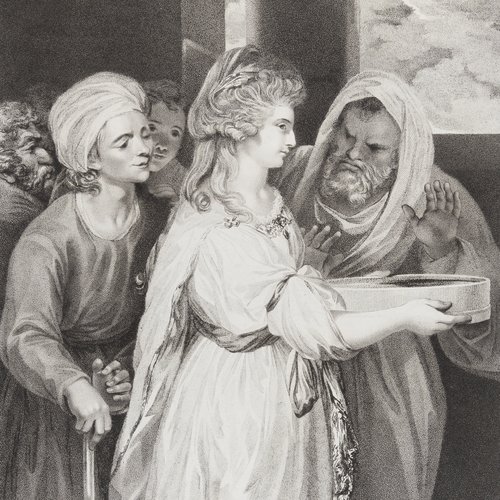
Peltro William Tomkins, [The Vestal], 1796, stipple and engraving, Syracuse University Art Museum, 2023.426
Interrogating Celebrity, Then and Now
The portrait serves as the focal point for the 2025-2026 Ray Smith Symposium, “(In)Visible Faces: The Politics of Portraiture and Social Change, 1700—the Present,” organized by Ray and Yuen. This international symposium, held on March 26 and 27, 2026, will bring together scholars across different disciplines to examine what Lyne's portrait represented in the 18th century and what it represents today—and to ask critical questions about who such portraits leave out and what structures of wealth, power and hierarchy they affirm.
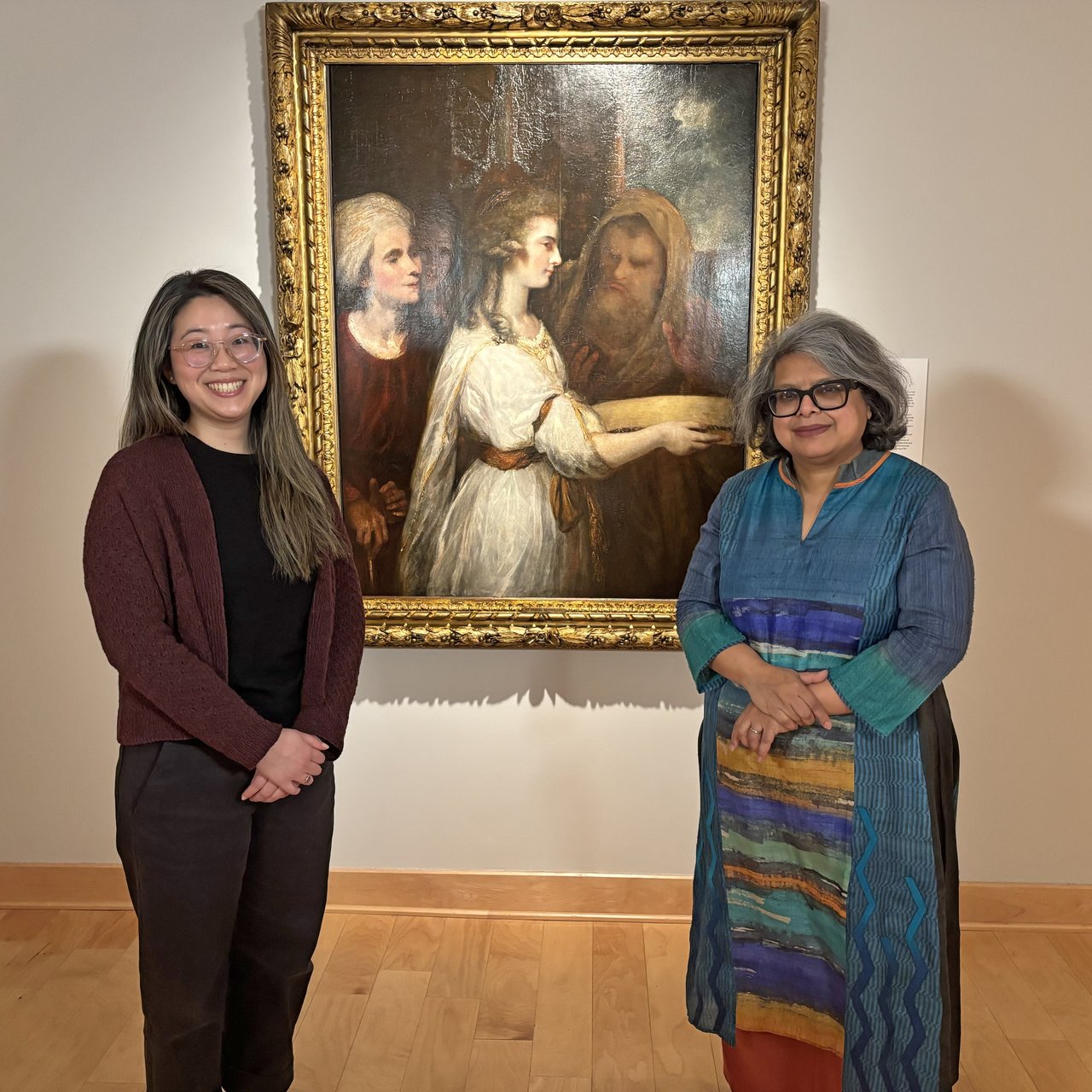
“Reynolds’s portrait of Mrs. Seaforth offers an extraordinary opportunity to interrogate the picture’s historic and contemporary legacies. Too often, disciplinary boundaries keep us locked in the past or the present, without examining how the past is continually yoked with the present and the future,” says Ray.
The interdisciplinary symposium features keynote lectures by Tim Barringer, Paul Mellon Professor of the History of Art at Yale University, and Nilanjana (Buju) Dasgupta, Provost Professor and Inaugural Director of the Institute of Diversity Sciences at the University of Massachusetts, Amherst.
They will be joined by curators, art historians and media scholars from the United States and United Kingdom, including Adam Eaker (Metropolitan Museum of Art); Jennifer Germann (Independent Scholar and Affiliated Scholar, Institute for European Studies, Cornell University); Alice Insley (Tate Britain); Joanna Marschner (Historic Royal Palaces); Elizabeth Mitchell (McNay Art Museum); Amelia Rauser (Franklin and Marshall College); Debarati Sarkar (CUNY Graduate Center); Raphael Shea (Westlake Art Conservation Center); Robert Travers (Cornell University); Kirsten Schoonmaker (College of Visual and Performing Arts, SU); Melinda Watt (Art Institute of Chicago); and Melissa Yuen (Syracuse University Art Museum).
Faculty and curators from Syracuse and Cornell Universities who will respond to the speakers and moderate the Question and Answer sessions include Durba Ghosh, Kate Holohan, Radha Kumar, Jeffrey Mayer, Srivi Ramasubramanian, Romita Ray, Irina Savinetskaya and Junko Takeda.
“We are excited to bring together such a distinguished group of scholars in partnership with the museum, the Special Collections Research Center (SCRC, Bird Library) and CODE^SHIFT (Newhouse School). Collaborating with SCRC curators Courtney Asztalos and Irina Savinetskaya, and Newhouse Professor of Communications Srividya (Srivi) Ramasubramanian, has broadened the lens of our inquiry to look at our rare books and photography collections, as well as the role of images in media studies. We hope that together with our students and faculty colleagues, we will gain fresh insights into the ongoing power of portraiture,” says Ray.
For Yuen, the symposium represents an opportunity for expansive thinking about how portraits function across time. "While it is a portrait of Mrs. Seaforth, it is also a historical work of art that had a really interesting life of its own during the 18th century," she says. "It was displayed publicly in London and descriptions of it were published and distributed. Tomkins's print was also circulated in 18th-century London and beyond."
The symposium will examine portraits as mobile objects that circulate through specific social and cultural spaces to reinforce ideas about race, class and gender—dynamics as relevant in the age of Instagram and TikTok as they were in Reynolds's London.
"Our understanding of a painting goes beyond what the artist depicts," Yuen says. "Our painting is one of Tuccia, the Vestal Virgin, but it can open up so many additional avenues of inquiry and discovery. This kind of interdisciplinary exploration is what I hope audiences gain from engaging with the painting. Histories are not simply frozen in the past—they have continued relevance."
From Reynolds' carefully constructed image of Rebecca Lyne to today's curated social media feeds, portraiture continues to shape who we see, how we see, and who we remember.
About the Ray Smith Symposium:
The Ray Smith Symposium takes its name from the Auburn, New York, native, who, after graduating from Syracuse in 1921, became a highly respected educator and administrator. All symposium events are free and open to the public. This year’s symposium is co-sponsored by Art and Music Histories; Chemistry; CODE^SHIFT; English; Goldring Arts, Style and Culture Journalism; History; Lender Center for Social Justice; Light Work; Premodern Global Studies; Ray Smith Symposium; South Asia Center; Syracuse University Art Museum; Syracuse University Humanities Center; Syracuse University Libraries; The Alexia at Newhouse; Women’s and Gender Studies; Psychology; and The Rubin Family Foundation. Ray and Yuen are especially grateful to Todd Rubin ’04, President, The Republic of Tea, for his generous support.
More about the 2025-2026 Ray Smith Symposium.
Published: Feb. 24, 2026
Media Contact: asnews@syr.edu