
Where Wells Run Deep, Biodiversity Runs Thin
Key Takeaways:
Long‑term footprint: Across Pennsylvania, legacy conventional oil-and-gas infrastructure was more strongly associated with declines in stream biodiversity than shale development.
Robust evidence base: The team analyzed more than 6,800 benthic macroinvertebrate samples in rivers collected over decades and paired them with watershed and well-record data.
Protecting the Environment: The findings highlight the need to prioritize regulation and remediation of older conventional well sites—especially inactive, abandoned and orphaned wells—to better protect stream ecosystems.
As the United States continues to lead global oil and gas production—accounting for roughly 20% of worldwide output in 2024—understanding how different extraction methods affect ecosystems has never been more urgent. A new study in ACS ES&T Water offers new clarity: conventional, often decades-old oil-and-gas infrastructure leaves a deeper, more persistent mark on freshwater biodiversity than unconventional shale (fracking) development.
Terms to know:
Conventional oil and gas is produced from reservoirs where hydrocarbons flow naturally into a drilled wellbore due to sufficient reservoir pressure and permeability.
Unconventional oil and gas refers to resources found in tight rock layers—like shale, sandstone and coal seams—where the hydrocarbons are trapped and require techniques such as horizontal drilling and high‑volume hydraulic fracturing to produce them cost‑effectively. Hydraulic fracturing requires significantly more water than conventional methods, and concerns have been raised regarding the potential for wastewater to contaminate drinking water.
The research was conducted by a multi-institutional team led by Ryan Olivier-Meehan, a former undergraduate and now a graduate student in the Department of Earth and Environmental Sciences (EES) in the College of Arts and Sciences at Syracuse University, in collaboration with EES Assistant Professor Tao Wen and partners at UCLA, Carnegie Institution for Science and the University of Colorado Boulder. Their analysis integrates ecology, geology and data science to move the conversation beyond assumptions and toward evidence-based environmental stewardship.
Pennsylvania as a Natural Laboratory
The study focused on streams in Pennsylvania, which Wen describes as the perfect natural laboratory. “Pennsylvania has a very long history of conventional oil and gas drilling with some wells dating back more than 100 years,” notes Wen. “At the same time, it has been at the center of modern shale gas development. On top of that, the state has a very strong stream monitoring program.”
This overlap of legacy infrastructure, newer technology and consistent biological data created a unique chance to compare ecological impacts at scale. “What makes this moment special is that we now have decades of high-quality biological monitoring data available,” Wen says. “That gave us a rare opportunity to step back and ask, what has all of this development meant for stream life at a statewide scale?”
Measuring Stream Health Using Native Organisms
To quantify ecological change, the team analyzed more than 6,800 benthic macroinvertebrate samples, which include bottom-dwelling insect larvae, small crustaceans and worms. They compared them across watershed characteristics and detailed oil-and-gas records. The team then applied modeling and network analysis to tease apart the relative influences of shale versus conventional development on community composition and biological integrity.
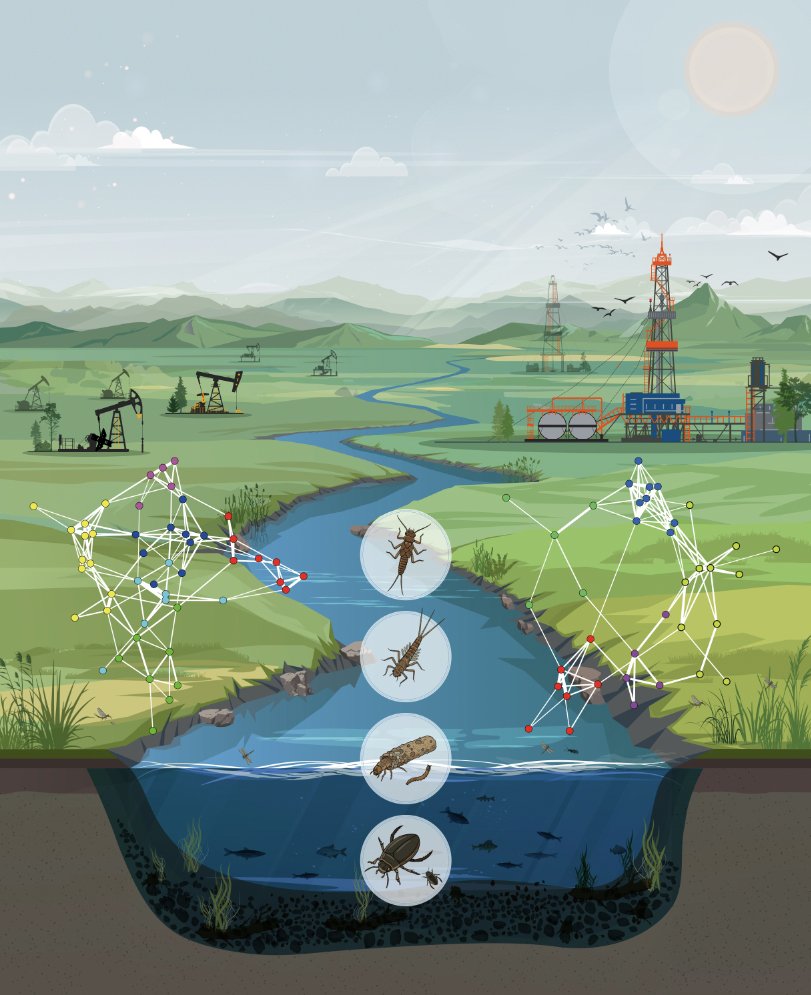
“Benthic macroinvertebrates are excellent indicators of stream health because they live in the water year-round, constantly exposed to local conditions” says Olivier-Meehan. “If conditions deteriorate, sensitive species disappear and are replaced by more tolerant ones. By looking at the community as a whole, we get a long-term picture of stream condition—not just a snapshot of water chemistry on a single day.”
These organisms also form the base of the food web. They recycle nutrients, break down organic matter and support fish and bird populations. Therefore, understanding how drilling affects their biodiversity is essential, because any disruption to these foundational species can ripple upward through the entire ecosystem and signal broader declines in watershed health.
Analyzing the Data
The statewide patterns were clear. Conventional development was linked with fewer species, less variety among them, and an overall decline in the ecosystem’s health. It also caused the community of aquatic organisms to shift toward hardy, pollution-tolerant species—signs that the ecosystem is becoming less resilient. The effects from shale development showed limited but detectable effects.
“Public debate often centers on shale gas because it’s newer and more visible. Our results show the story is more nuanced,” says Olivier-Meehan. “In Pennsylvania, conventional drilling—much more widespread and often decades old—was more strongly associated with declines in stream biodiversity.”
The researchers stress that this does not imply shale development is impact-free. Rather, environmental risk reflects the age and density (number of wells within a specific region) along with infrastructure, regulatory oversight and landscape factors that influence ecological impacts.
Implications and What Comes Next
Beyond Pennsylvania, Wen sees broad applicability. “While our study focuses on Pennsylvania, many other states and countries have similar histories of conventional oil and gas development,” he says. “The broader message—that legacy infrastructure can have lasting ecological effects—likely applies elsewhere. Our framework provides a way to evaluate cumulative impacts and prioritize restoration where it will matter most.”
The team’s next steps include examining how outcomes differ based on the density of inactive, abandoned and orphaned wells, their proximity to streams and local geology, as well as expanding the analysis to other regions. “Our goal is to help communities make informed decisions that balance energy needs with environmental protection,” Wen says. “Good long-term monitoring lets us move beyond assumptions to evidence-based conversations about sustainability.”
Funding and Acknowledgments:
This research was supported by the National Science Foundation (NSF), Grant No. OAC-2209864 (to Tao Wen).
Citation:
Olivier-Meehan, Ryan; Levi Simons, Ariel; Prabhu, Anirudh; Carter, Elizabeth; Basijokaite, Ruta; Lackey, Greg; Wen, Tao. (2026). The Legacy of Conventional Oil and Gas Development Outweighs Shale Gas Impacts on Stream Biodiversity. ACS ES&T Water. DOI: https://doi.org/10.1021/acsestwater.5c01413
Published: March 5, 2026
Media Contact: asnews@syr.edu