
Have You Ever...Met C. elegans?
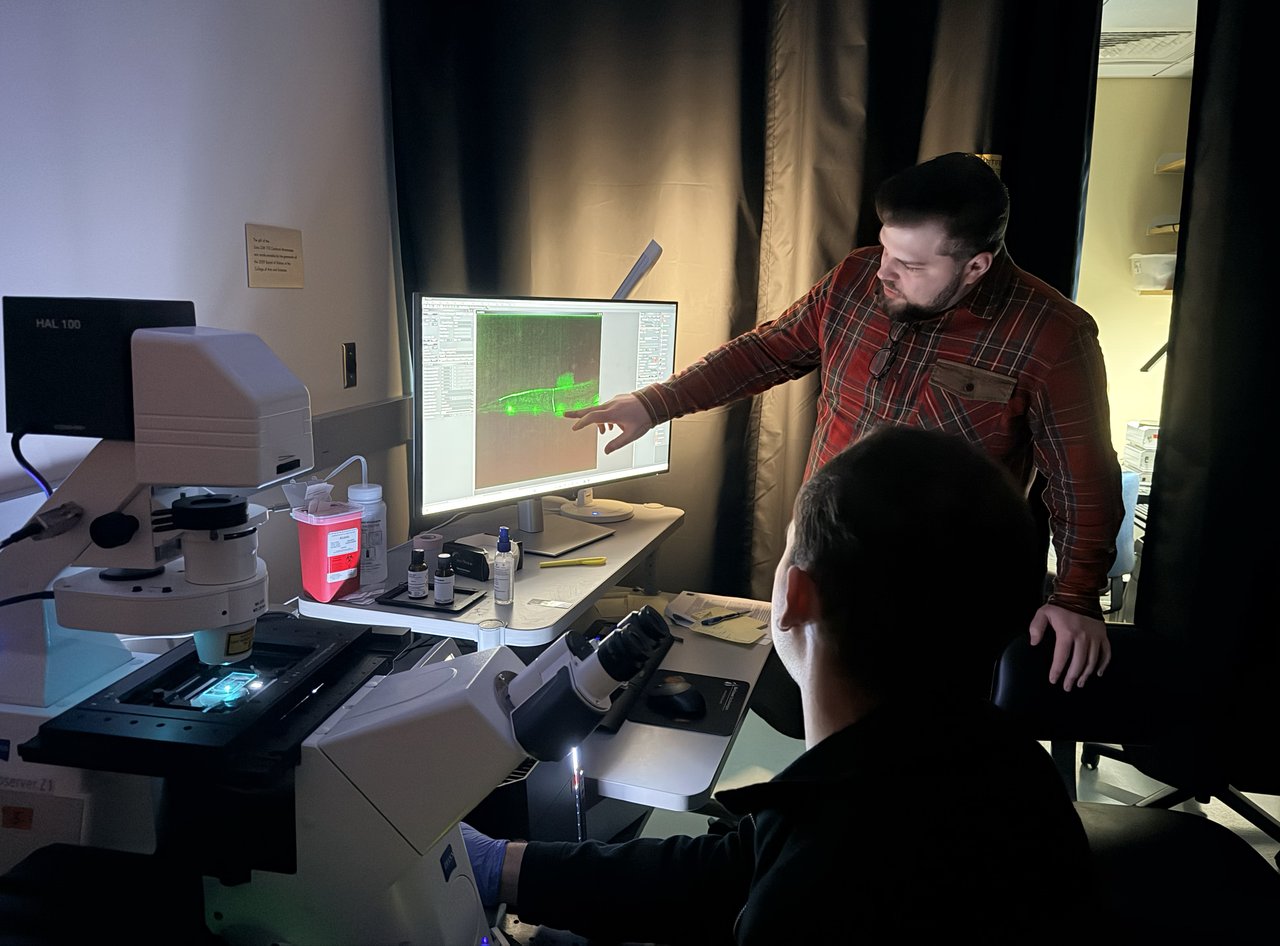
Ever wonder what's happening in the classroom down the hall or the lab two buildings over? We do too, and we're doing something about it.
The Arts and Sciences communications team is making its way across the College, into labs, offices, archives and classrooms, to meet our accomplished colleagues and introduce them to you. With hundreds of faculty and staff across dozens of departments and centers, there's no shortage of remarkable people and projects to discover.
Recent stop: Neuroscience research labs in the biology wing of the Life Sciences Complex, where faculty and students investigate everything from memory and aging to neurodevelopment and neurodegenerative disease.
Neuroscience is an interdisciplinary field focused on understanding the development, function and pathology of the nervous system. Researchers in this program study the brain and nervous system at multiple levels, applying molecular, genetic, biochemical and imaging techniques to questions related to neuroplasticity, memory, stress, stroke, epilepsy, autism spectrum disorders and Alzheimer's disease.
What we found: Faculty and student researchers tackling some of the most complex questions in biology and human health. During our visit, we learned about new faculty members whose research spans neurodegeneration, memory formation, neuronal identity and brain development.
Highlights included learning how Jayson Smith uses the microscopic roundworm Caenorhabditis elegans to investigate how neurons maintain their identity and function throughout life, how Isabel Salas studies mechanisms that could improve memory function in Alzheimer's disease, and how Chih Hung Lo's lab uses advanced imaging and disease models to explore how lysosomes, the cell's recycling and waste-removal centers, help maintain healthy brain cells. We also learned about Jessica MacDonald's research on how genetic and environmental factors influence brain development and cognitive function.
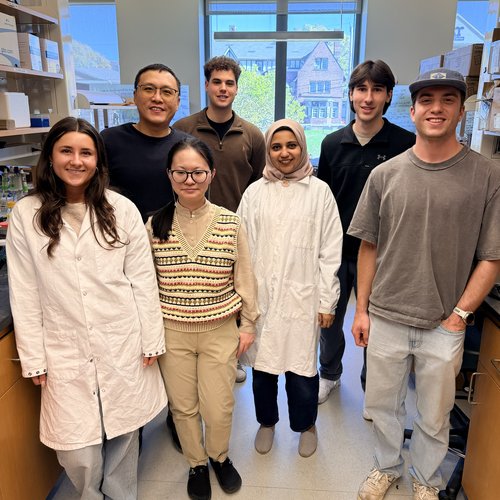
Biology assistant professor Chih Hung Lo (back, left) and members of his lab group.
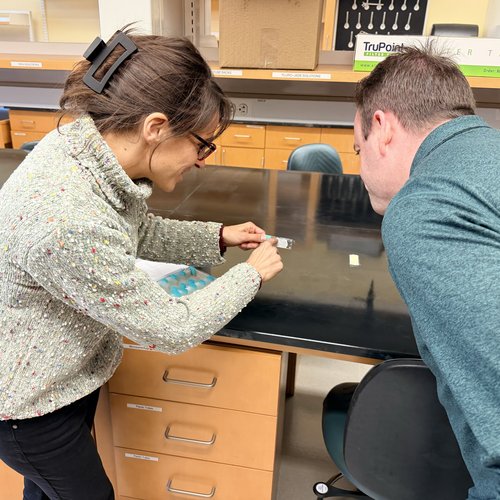
Isabel Salas (left), assistant professor of biology, shows A&S communications specialist Sean Grogan a laboratory sample.
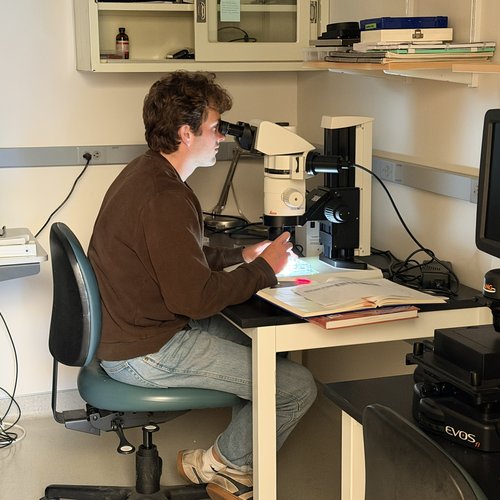
Graduate student Luke Maresca, a member of associate professor Jessica MacDonald’s lab, examines a sample under a microscope.
Fun fact: The tiny roundworm C. elegans is one of neuroscience's most powerful model organisms. Its simple nervous system allows scientists to study every neuron in the animal and connect genes, neural circuits and behavior in ways that are difficult to achieve in more complex species. The insights gained often reveal biological principles that apply broadly across animals, including humans.
Throughout the visit, faculty shared how their research connects fundamental biological discovery to real-world health challenges, from understanding how neurons survive for decades to identifying potential pathways for treating Alzheimer's disease, Rett syndrome and other neurological disorders. The conversations generated numerous story ideas and offered a deeper appreciation for the collaborative neuroscience research happening across A&S.
The A&S communications team spotlights faces and spaces across the College. Where should we visit next? What faculty or staff member do you think your colleagues should read about? Reach out through our contact form for consideration.
Published: Nov. 2, 2026
Media Contact: asnews@syr.edu