
Ph.D. Student Recognized for Research on Islam and Indigenous Traditions
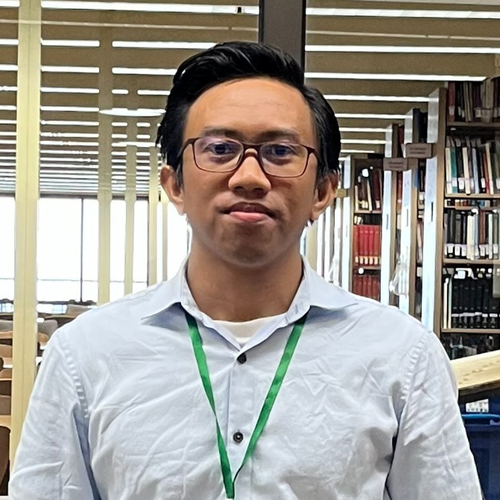
Andi Alfian
When religion scholars from across the world come together to share their research, they can foster intercultural understanding and promote a more nuanced public view of diverse communities. Andi Alfian, a Ph.D. student in religion at Syracuse University's College of Arts and Sciences, recently presented his work on Islam and Indigenous Indonesian religious traditions at the 2025 Centre for Indonesian Law, Islam and Society (CILIS) Islamic Studies Postgraduate Conference, where his presentation was recognized among the top three.
Conference Recognition
Alfian, a Fulbright doctoral scholar at Syracuse, shared his research project titled "Provincializing Muslim Indigenous in Sulawesi: Unsettling the Boundaries of Islam and Indigenous Religious Traditions" at the virtual conference on November 11, 2025 hosted by the University of Melbourne, Australia. The conference convened postgraduate students from around the world who are researching topics relating to Islam. Participants were mentored by leading scholars and researchers who served as panel chairs, including Professor Tim Lindsey (The University of Melbourne), Professor Julian Millie (Monash University, Australia), Professor Halim Rane (Griffith University, Australia), Dina Afrianty Ph.D. (The Australian Catholic University), Maria Bhatti Ph.D. (The University of Western Sydney), and Associate Professor Nadirsyah Hosen (The University of Melbourne).
Alfian's ongoing scholarship examines Indigenous peoples in Sulawesi, an island in Indonesia, who identify as Muslim while practicing Indigenous religious traditions in their daily lives. His approach challenges frameworks that often marginalize or misrepresent Indigenous religions. Focusing on the Bara and Cindakko, two Indigenous communities in Sulawesi's mountainous regions, his work demonstrates that rituals, ecological knowledge and everyday practices can honor both Islamic identity and ancestral traditions.
New Book Chapter
Building on the themes of Indigenous identity and relational worldviews highlighted in his conference presentation, Alfian further expands his scholarship in Religion, Decolonization, and the Planetary Community: Voices from the Indonesian Archipelago (Routledge, 2025).
Alfian's research was published in Religion, Decolonization, and the Planetary Community: Voices from the Indonesian Archipelago.
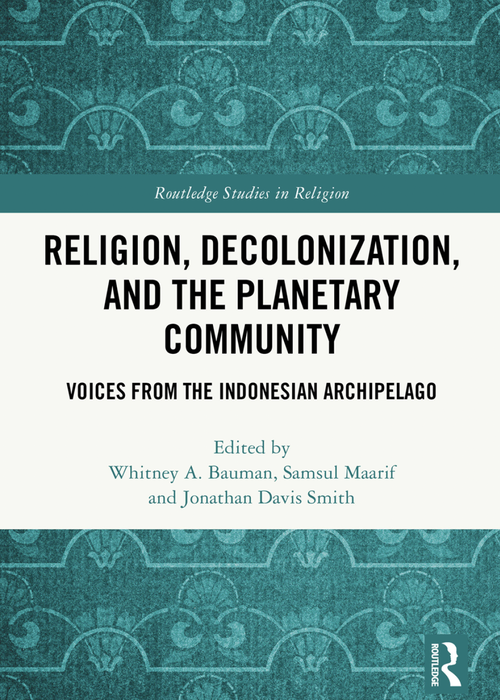
Alfian's research was published in Religion, Decolonization, and the Planetary Community: Voices from the Indonesian Archipelago.
In his book chapter, “Decolonizing Human–Animal Relations in Indonesia: Insights from Bara, Cindakko, and Tobalo Indigenous Communities in Sulawesi,” Alfian examines how three Indigenous communities understand, care for and relate to animals as integral subjects in healing, ritual and cosmological life.
Drawing on ethnographic research, he shows that animals in these communities are not viewed as inferior beings but as relational companions woven into ecological knowledge, kinship and multispecies ethics and everyday religious practice. This perspective challenges Western hierarchical assumptions about human–animal divides and contributes to emerging conversations about multispecies religiosities within religious studies.
The chapter’s insights reinforce a key theme in Alfian’s work: Indigenous cosmologies—whether expressed in relations with land, ancestors, or animals—offer alternative frameworks for understanding religion, identity and planetary life grounded in lived experience rather than colonial categories.
In addition to his doctoral studies at Syracuse University, Alfian is the founder of Sekolah Anak Muda, a nonprofit in Eastern Indonesia that hosts public discussions on youth, Indigenous and environmental issues. He holds a bachelor's degree in philosophy and religious studies from Universitas Islam Negeri (UIN) Alauddin Makassar and a master's degree in religious studies from Universitas Gadjah Mada (UGM) Yogyakarta, both in Indonesia.
Published: Feb. 19, 2026
Media Contact: asnews@syr.edu